Ch. 5 The Integumentary System
Marieb - Human Anatomy & Physiology 7th Edition
Marieb, Hoehn7th EditionHuman Anatomy & PhysiologyISBN: 9780805359091Non è quello che usi tu?Cambia libro di testo
Capitolo 5, Problema 24

Mrs. Gaucher received second-degree burns on her abdomen when she dropped a kettle of boiling water. She asked her doctor (worriedly) if she would need a skin graft. What do you think he told her?

Guida verificata passo dopo passo
1
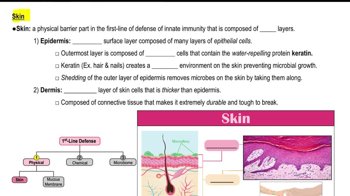
Step 1: Understand the classification of burns by degree. First-degree burns affect only the epidermis, second-degree burns affect the epidermis and part of the dermis, and third-degree burns extend through the entire dermis and possibly deeper tissues.
Step 2: Recognize that second-degree burns typically cause blistering, redness, and pain because they damage the epidermis and part of the dermis but leave some dermal structures intact.
Step 3: Know that because some dermal tissue remains in second-degree burns, the skin can often regenerate on its own without the need for a skin graft, as the remaining dermis contains cells necessary for healing.
Step 4: Contrast this with third-degree burns, where the damage is so extensive that the skin cannot regenerate properly, often necessitating a skin graft to restore the skin barrier.
Step 5: Conclude that the doctor likely reassured Mrs. Gaucher that, since her burns were second-degree, she probably would not need a skin graft and that her skin should heal with proper care and treatment.

Risposta video verificata per un problema simile:

Questa soluzione video è stata consigliata dai nostri tutor come utile per risolvere questo problema.
Durata del video:
2m

Concetti chiave

Ecco i concetti essenziali che devi comprendere per rispondere correttamente alla domanda.

Second-Degree Burns

Second-degree burns affect both the outer layer (epidermis) and the underlying layer (dermis) of the skin. They typically cause redness, swelling, blistering, and pain. These burns usually heal within 2-3 weeks without scarring if properly treated, but deeper second-degree burns may require more intensive care.
Video consigliato:
Percorso guidato
02:52
Second Law of Thermodynamics

Skin Grafting

Skin grafting is a surgical procedure where healthy skin is transplanted to cover areas of damaged or missing skin. It is often necessary for deep burns that cannot heal on their own or when large areas of skin are lost. For superficial or moderate second-degree burns, skin grafts are usually not required.
Video consigliato:

Burn Treatment and Healing Process

Treatment of second-degree burns involves cleaning, protecting the wound, and preventing infection. Proper wound care promotes natural healing by the skin’s regenerative capacity. Most second-degree burns heal without surgery, but monitoring is essential to decide if grafting is needed for deeper or infected wounds.
Video consigliato:
Percorso guidato
04:19
1) RNA Processing