Ch. 17 The Special Senses
Martini - Fundamentals of Anatomy & Physiology 11th Edition
Martini, Nath, Bartholomew11th EditionFundamentals of Anatomy & PhysiologyISBN: 9780136874089Non è quello che usi tu?Cambia libro di testo
Capitolo 17, Problema 24

You are at a park watching some deer 35 feet away from you. A friend taps you on the shoulder to ask a question. As you turn to look at your friend, who is standing just 2 feet away, what changes would your eyes undergo?

Guida verificata passo dopo passo
1
Understand that when you shift your gaze from a distant object (the deer 35 feet away) to a nearby object (your friend 2 feet away), your eyes must adjust to focus clearly on the new distance. This process is called accommodation.
Accommodation involves the ciliary muscles in the eye contracting to change the shape of the lens. Specifically, the lens becomes thicker and more curved to increase its refractive power, allowing light rays from the closer object to focus properly on the retina.
In addition to accommodation, your eyes will also undergo convergence, where both eyeballs rotate inward toward the nose to align the image of the close object on corresponding points of both retinas, enabling single binocular vision.
Pupil constriction often accompanies accommodation and convergence to increase the depth of field and improve focus on the near object by reducing the amount of light entering the eye.
Summarize that these changes—lens thickening (accommodation), eye rotation inward (convergence), and pupil constriction—work together to help your eyes shift focus from the distant deer to your nearby friend.

Risposta video verificata per un problema simile:

Questa soluzione video è stata consigliata dai nostri tutor come utile per risolvere questo problema.

Concetti chiave

Ecco i concetti essenziali che devi comprendere per rispondere correttamente alla domanda.

Accommodation of the Eye

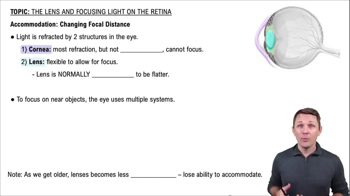
Accommodation is the process by which the eye's lens changes shape to focus on objects at different distances. When looking at a nearby object, the ciliary muscles contract, making the lens thicker to increase its refractive power. Conversely, for distant objects, the lens flattens. This adjustment ensures a clear image is formed on the retina.
Video consigliato:
5:58
Accommodation: Changing Focal Distance

Pupil Constriction and Dilation

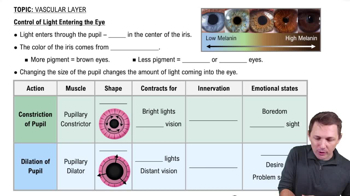
The pupil controls the amount of light entering the eye and adjusts based on focus distance. When focusing on near objects, the pupil constricts to increase the depth of field and reduce spherical aberrations. For distant objects, the pupil dilates to allow more light in, aiding vision under lower light conditions.
Video consigliato:
8:07
Control of Light Entering the Eye

Convergence of the Eyes

Convergence is the inward movement of both eyes toward each other to maintain single binocular vision when viewing close objects. As the friend is only 2 feet away, your eyes will converge more compared to when looking at the deer 35 feet away. This helps align the images on the retinas for proper depth perception.
Video consigliato:
8:07
Control of Light Entering the Eye
Pratica correlata
Domanda del libro di testo

Your friend Shelly suffers from myopia (nearsightedness). You remember from your physics class that concave lenses cause light waves to spread or diverge and that convex lenses cause light waves to converge. What type of corrective lenses would you suggest to your friend?

(a) Concave lenses

(b) Convex lenses

725
views
Domanda del libro di testo

Juan tells his physician that he has been feeling dizzy, especially when he closes his eyes. He is asked to stand with his feet together and arms extended forward. As long as he keeps his eyes open, he exhibits very little movement. But when he closes his eyes, his body begins to sway a great deal, and his arms tend to drift together toward the left side of his body. Why does this occur?

774
views
Domanda del libro di testo

What are the three auditory ossicles in the middle ear, and what are their functions?

1419
views
Domanda del libro di testo

Damage to the ampullary cupula of the lateral semicircular duct would interfere with the perception of

(a) The direction of gravitational pull

(b) Linear acceleration

(c) Horizontal rotation of the head

(d) Vertical rotation of the head

(e) Angular rotation of the head

754
views
Domanda del libro di testo

Displacement of stereocilia toward the kinocilium of a hair cell

(a) Produces a depolarization of the membrane

(b) Produces a hyperpolarization of the membrane

(c) Decreases the membrane permeability to sodium ions

(d) Increases the membrane permeability to potassium ions

(e) Does not affect the membrane potential of the cell

925
views