
Ch. 20 The Heart
Martini - Fundamentals of Anatomy & Physiology 11th Edition
Martini, Nath, Bartholomew11th EditionFundamentals of Anatomy & PhysiologyISBN: 9780136874089Non è quello che usi tu?Cambia libro di testo
Capitolo 20, Problema 19

Which of the following is longer?
(a) The refractory period of a cardiac contractile cell.
(b) The refractory period of skeletal muscle fiber.

Guida verificata passo dopo passo
1
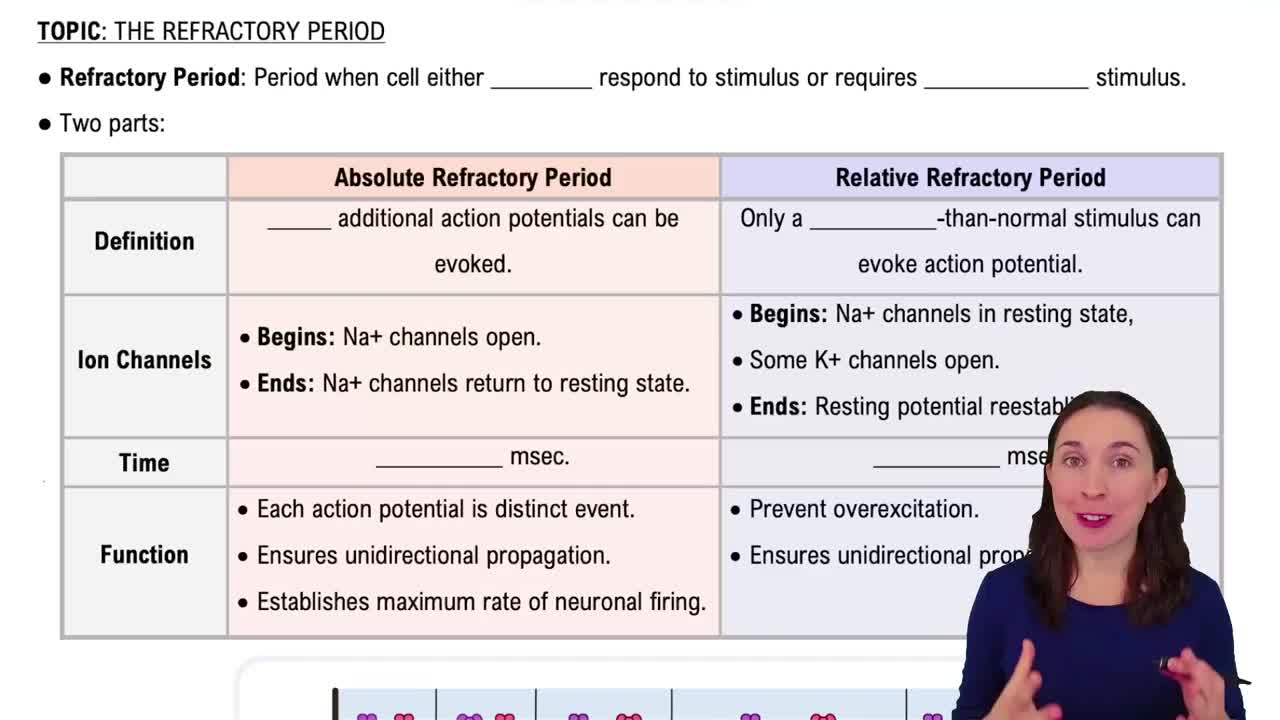
Step 1: Understand what the refractory period means in muscle physiology. The refractory period is the time during which a muscle cell cannot be re-excited after an action potential has occurred.
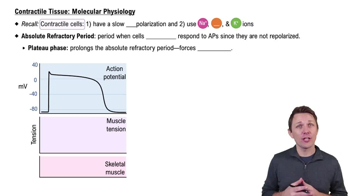
Step 2: Recall that cardiac contractile cells have a unique action potential characterized by a plateau phase, which prolongs their refractory period to prevent tetanus and allow proper heart filling.
Step 3: Compare this to skeletal muscle fibers, which have a much shorter refractory period because their action potentials are brief, allowing rapid repeated contractions.
Step 4: Recognize that the longer refractory period in cardiac muscle ensures rhythmic contractions and prevents summation, while the shorter refractory period in skeletal muscle allows for quick, repeated contractions.
Step 5: Conclude that the refractory period of a cardiac contractile cell is longer than that of a skeletal muscle fiber due to the physiological differences in their action potentials and functional requirements.

Risposta video verificata per un problema simile:

Questa soluzione video è stata consigliata dai nostri tutor come utile per risolvere questo problema.

Concetti chiave

Ecco i concetti essenziali che devi comprendere per rispondere correttamente alla domanda.

Refractory Period

The refractory period is the time during which a muscle cell cannot be re-excited after an action potential. It ensures proper timing of contractions and prevents continuous, uncontrolled stimulation. Understanding this period is essential to compare different muscle types.
Video consigliato:
06:26
Refractory Period

Cardiac Contractile Cell Physiology

Cardiac contractile cells have a prolonged action potential due to calcium influx, resulting in a longer refractory period. This extended refractory period prevents tetanus and allows the heart to relax between beats, ensuring effective pumping.
Video consigliato:
9:39
Contractile Tissue: Molecular Physiology

Skeletal Muscle Fiber Physiology

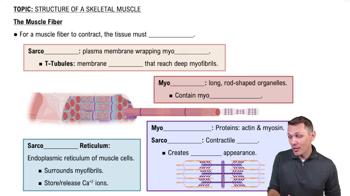
Skeletal muscle fibers have a shorter refractory period because their action potentials are brief, allowing rapid repeated contractions. This enables skeletal muscles to sustain tetanic contractions necessary for voluntary movements.
Video consigliato:
7:47
The Muscle Fiber