
Ch. 7 The Axial Skeleton
Martini - Fundamentals of Anatomy & Physiology 11th Edition
Martini, Nath, Bartholomew11th EditionFundamentals of Anatomy & PhysiologyISBN: 9780136874089Non è quello che usi tu?Cambia libro di testo
Capitolo 7, Problema 3

The unpaired facial bones include the:
(a) Lacrimal and nasal
(b) Vomer and mandible
(c) Maxilla and mandible
(d) Zygomatic and palatine

Guida verificata passo dopo passo
1
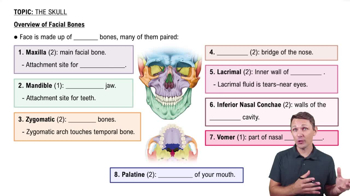
Step 1: Understand the difference between paired and unpaired facial bones. Paired bones occur as two symmetrical bones on each side of the face, while unpaired bones are single bones located along the midline of the face.
Step 2: Identify the bones listed in each option and determine whether they are paired or unpaired. For example, the lacrimal and nasal bones are paired, meaning there is one on each side of the face.
Step 3: Recall that the vomer is an unpaired bone forming part of the nasal septum, and the mandible is a single bone forming the lower jaw, so both are unpaired.
Step 4: Recognize that the maxilla, zygomatic, and palatine bones are paired bones, present on both sides of the face.
Step 5: Based on this analysis, select the option that correctly lists only unpaired facial bones.

Risposta video verificata per un problema simile:

Questa soluzione video è stata consigliata dai nostri tutor come utile per risolvere questo problema.
Durata del video:
2m

Concetti chiave

Ecco i concetti essenziali che devi comprendere per rispondere correttamente alla domanda.

Unpaired Facial Bones

Unpaired facial bones are single bones located along the midline of the face, meaning there is only one of each. These bones are distinct from paired bones, which occur in symmetrical pairs on both sides of the face.
Video consigliato:
6:30
Overview of Facial Bones

Examples of Unpaired Facial Bones

The main unpaired facial bones include the mandible, which forms the lower jaw, and the vomer, which forms part of the nasal septum. Recognizing these helps differentiate them from paired bones like the maxilla or zygomatic bones.
Video consigliato:
6:30
Overview of Facial Bones

Paired vs. Unpaired Bone Identification

Understanding the difference between paired and unpaired bones is essential for anatomy. Paired bones appear on both sides of the face (e.g., nasal, lacrimal), while unpaired bones are singular and central, aiding in correctly answering questions about bone classification.
Video consigliato:
2:21
Microscopic Anatomy of Bones - Bone Cells Example 1