

Ch. 8 The Appendicular Skeleton
Martini - Fundamentals of Anatomy & Physiology 11th Edition
Martini, Nath, Bartholomew11th EditionFundamentals of Anatomy & PhysiologyISBN: 9780136874089Non è quello che usi tu?Cambia libro di testo
Capitolo 8, Problema 26

Investigators find the pelvis of a human and are able to identify the sex, the relative age, and some physical characteristics of the person. How is this possible from only the pelvis?

Guida verificata passo dopo passo
1
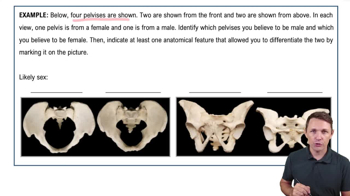
Understand that the pelvis is a key skeletal structure that exhibits distinct differences between males and females, which allows investigators to determine sex. For example, female pelves tend to be wider and have a larger pelvic inlet to facilitate childbirth, while male pelves are generally narrower and more robust.
Recognize that age estimation can be made by examining the pelvis because certain features change predictably over time. For instance, the degree of fusion of pelvic bones, the texture of the bone surface, and the wear on the pubic symphysis can indicate whether the individual was young, middle-aged, or elderly.
Note that physical characteristics such as body size and muscle attachment sites can be inferred from the pelvis. Robust muscle attachment areas suggest stronger musculature, which can give clues about the person's physical activity or build.
Combine observations of pelvic morphology, bone texture, and wear patterns to form a comprehensive profile of the individual’s sex, age, and physical traits.
Summarize that the pelvis serves as a biological record because its shape and condition reflect both genetic sex differences and changes due to aging and lifestyle, making it a valuable tool in forensic and anthropological investigations.

Risposta video verificata per un problema simile:

Questa soluzione video è stata consigliata dai nostri tutor come utile per risolvere questo problema.
Durata del video:
2m

Concetti chiave

Ecco i concetti essenziali che devi comprendere per rispondere correttamente alla domanda.

Sexual Dimorphism in the Pelvis

The human pelvis exhibits distinct differences between males and females, known as sexual dimorphism. Female pelves are generally wider and have a larger pelvic inlet to facilitate childbirth, while male pelves are narrower and more robust. These structural differences allow forensic anthropologists to estimate the sex of an individual from pelvic bones.
Video consigliato:
Percorso guidato
04:44
Asexual vs. Sexual Reproduction

Age Estimation from Pelvic Features

Certain features of the pelvis change predictably with age, such as the fusion of pelvic bones and the wear on joint surfaces. For example, the pubic symphysis undergoes morphological changes that can be used to estimate an individual's relative age at death. These age-related markers help investigators determine how old the person was.
Video consigliato:
3:01
The Pelvic Girdle Example 2

Physical Characteristics Inferred from Pelvic Morphology

The pelvis can reveal physical traits like body size, stature, and sometimes ancestry through its shape and robustness. Muscle attachment sites and bone thickness provide clues about the individual's physical activity and health. These characteristics help build a biological profile from skeletal remains.
Video consigliato:
3:01
The Pelvic Girdle Example 2