Ch. 11 The Muscular System
Martini - Fundamentals of Anatomy & Physiology 12th Edition
Martini, Nath, Bartholomew12th EditionFundamentals of Anatomy & PhysiologyISBN: 9780137854011Non è quello che usi tu?Cambia libro di testo
Capitolo 11, Problema 6

The muscles of facial expression are innervated by cranial nerve
(a) VII
(b) V
(c) IV
(d) VI

Guida verificata passo dopo passo
1
Identify the cranial nerves involved in motor innervation of the face. The muscles of facial expression are controlled by a specific cranial nerve responsible for motor function.
Recall that cranial nerve V (trigeminal nerve) primarily provides sensory innervation to the face and motor innervation to the muscles of mastication, not facial expression.
Understand that cranial nerve IV (trochlear nerve) and cranial nerve VI (abducens nerve) are involved in eye movement, not facial expression.
Recognize that cranial nerve VII (facial nerve) is the nerve that innervates the muscles of facial expression, allowing for movements such as smiling, frowning, and blinking.
Conclude that the correct answer is cranial nerve VII, as it is the motor nerve responsible for the muscles of facial expression.

Risposta video verificata per un problema simile:

Questa soluzione video è stata consigliata dai nostri tutor come utile per risolvere questo problema.
Durata del video:
3m

Concetti chiave

Ecco i concetti essenziali che devi comprendere per rispondere correttamente alla domanda.

Muscles of Facial Expression

These muscles control facial movements such as smiling, frowning, and blinking. They are unique because they insert into the skin rather than bones, allowing expressive movements. Understanding their anatomy is essential to link them with their nerve supply.
Video consigliato:
6:30
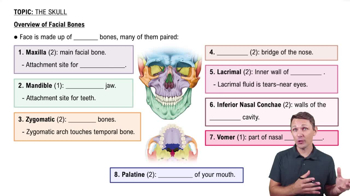
Overview of Facial Bones

Cranial Nerve VII (Facial Nerve)

Cranial nerve VII, known as the facial nerve, is primarily responsible for innervating the muscles of facial expression. It also carries some sensory and parasympathetic fibers, but its motor function is key for facial muscle control.
Video consigliato:
2:25
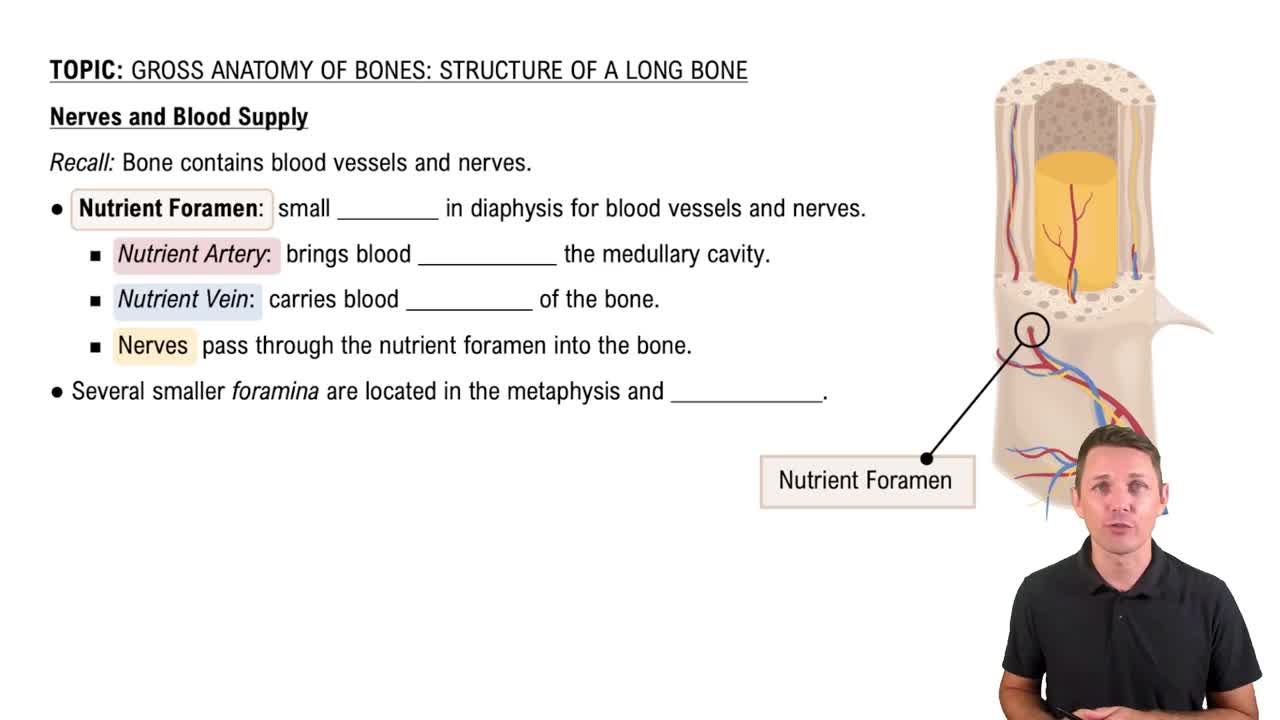
Nerves and Blood Supply

Other Cranial Nerves and Their Functions

Cranial nerves V, IV, and VI have different roles: V (trigeminal) provides sensory innervation to the face and motor to mastication muscles; IV (trochlear) and VI (abducens) control eye movements. Differentiating these nerves helps identify the correct nerve for facial muscles.
Video consigliato:
8:20
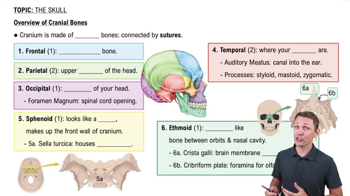
Overview of Cranial Bones