Why is it difficult to lift a heavy object when the elbow is at full extension?
Ch. 11 The Muscular System

Martini, Nath, Bartholomew12th EditionFundamentals of Anatomy & PhysiologyISBN: 9780137854011Non è quello che usi tu?Cambia libro di testo
Capitolo 11, Problema 26
Why can a pennate muscle generate more tension than can a parallel muscle of the same size?
Guida verificata passo dopo passo1
Understand the basic difference in muscle fiber arrangement: a parallel muscle has fibers running parallel to the force-generating axis, while a pennate muscle has fibers arranged at an angle to this axis.
Recognize that the force a muscle can generate is proportional to its physiological cross-sectional area (PCSA), which accounts for the total area of all muscle fibers perpendicular to their length.
Note that in pennate muscles, because fibers are angled, more fibers can be packed into the same muscle volume compared to parallel muscles, increasing the PCSA.
Use the relationship that the total force generated by the muscle is the sum of the forces produced by all fibers, so a greater PCSA means greater total force despite the angle of fibers.
Conclude that although each fiber in a pennate muscle contributes less force along the muscle's line of action due to the angle, the increased number of fibers (and thus greater PCSA) allows the pennate muscle to generate more overall tension than a parallel muscle of the same size.

Risposta video verificata per un problema simile:
Questa soluzione video è stata consigliata dai nostri tutor come utile per risolvere questo problema.
Durata del video:
2mConcetti chiave
Ecco i concetti essenziali che devi comprendere per rispondere correttamente alla domanda.
Muscle Architecture
Muscle architecture refers to the arrangement of muscle fibers relative to the force-generating axis. Pennate muscles have fibers oriented at an angle to the tendon, allowing more fibers to pack into a given volume, while parallel muscles have fibers aligned along the force axis.
Video consigliato:
Introduction to Muscles and Muscle Tissue Example 1
Physiological Cross-Sectional Area (PCSA)
PCSA is the total cross-sectional area of all muscle fibers perpendicular to their direction. Pennate muscles have a larger PCSA than parallel muscles of the same size, enabling them to generate greater force because tension is proportional to PCSA.
Video consigliato:
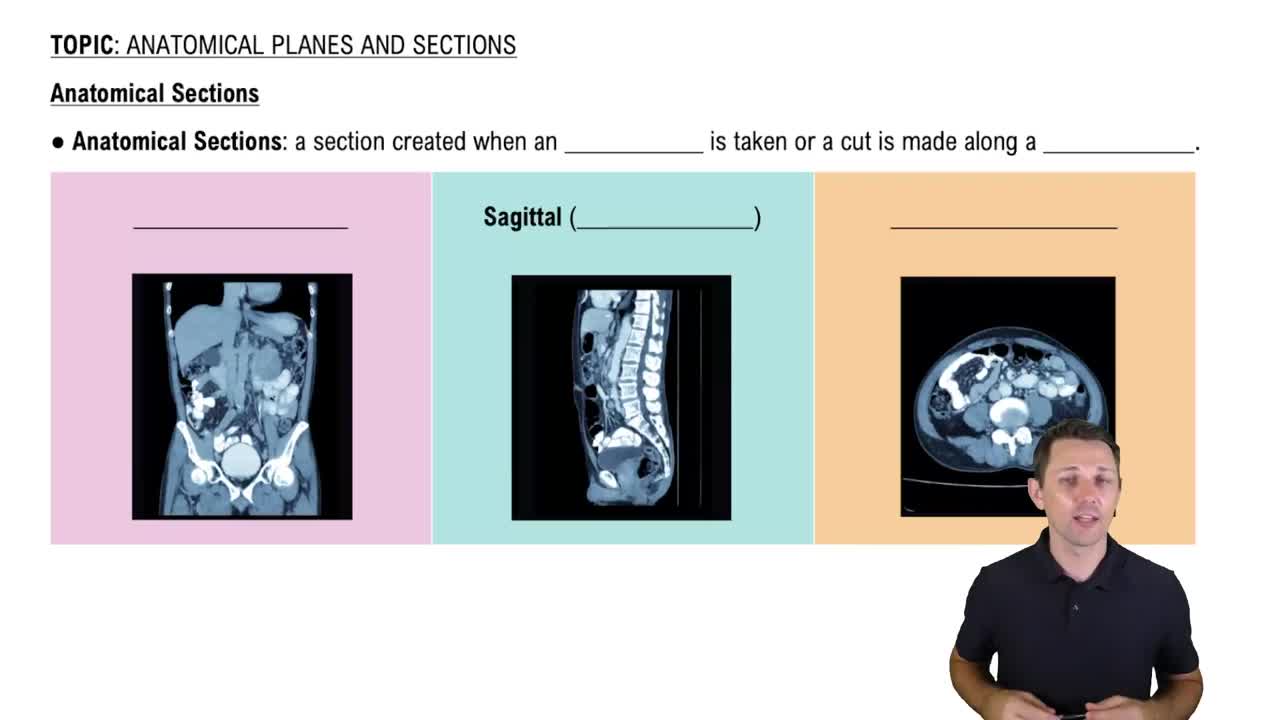
Anatomical Sections
Force Generation and Fiber Angle
In pennate muscles, fibers pull at an angle, so individual fiber force contributes less directly to tendon force. However, the increased number of fibers compensates for this, resulting in higher overall tension compared to parallel muscles where fibers pull directly along the tendon.
Video consigliato:
Percorso guidato
General Blood Vessel Structure
Pratica correlata
Domanda del libro di testo
864
views
Domanda del libro di testo
Why does a convergent muscle exhibit more versatility when contracting than does a parallel muscle?
1284
views
Domanda del libro di testo
Elongated bursae that reduce friction and surround the tendons that cross the posterior and anterior surfaces of the wrist form___.
1006
views
Domanda del libro di testo
Mary sees Jill coming toward her and immediately contracts her frontalis and procerus. She also contracts her right levator labii. Is Mary glad to see Jill? How can you tell?
856
views
Domanda del libro di testo
Mary's newborn is having trouble suckling. The doctor suggests that it may be a problem with a particular muscle. What muscle is the doctor probably referring to?
(a) Orbicularis oris
(b) Buccinator
(c) Masseter
(d) Risorius
(e) Zygomaticus
902
views
Domanda del libro di testo
The muscles of the vertebral column include many posterior extensors but few anterior flexors. Why?
1018
views