Ch. 2 The Chemical Level of Organization
Martini - Fundamentals of Anatomy & Physiology 12th Edition
Martini, Nath, Bartholomew12th EditionFundamentals of Anatomy & PhysiologyISBN: 9780137854011Non è quello che usi tu?Cambia libro di testo
Capitolo 2, Problema 28

The hydrogen bonding that occurs in water is responsible for all of the following except
(a) The high boiling point of water
(b) The low freezing point of water
(c) The ability of water to dissolve nonpolar substances
(d) The ability of water to dissolve inorganic salts
(e) The surface tension of water

Guida verificata passo dopo passo
1
Step 1: Understand what hydrogen bonding in water is. Hydrogen bonds are weak attractions between the slightly positive hydrogen atoms of one water molecule and the slightly negative oxygen atoms of another water molecule. This bonding gives water many unique properties.
Step 2: Analyze each option in the context of hydrogen bonding. For example, hydrogen bonding contributes to water's high boiling point because it requires more energy to break these bonds during phase changes.
Step 3: Consider the freezing point of water. Hydrogen bonding actually raises the freezing point compared to similar molecules without hydrogen bonding, so the 'low freezing point' is not due to hydrogen bonding.
Step 4: Evaluate water's ability to dissolve substances. Water dissolves inorganic salts well because of its polarity and hydrogen bonding, but it does not dissolve nonpolar substances effectively since nonpolar molecules cannot form hydrogen bonds with water.
Step 5: Review surface tension. Hydrogen bonding causes water molecules to stick together at the surface, creating high surface tension. Based on this analysis, identify which property is not caused by hydrogen bonding.

Risposta video verificata per un problema simile:

Questa soluzione video è stata consigliata dai nostri tutor come utile per risolvere questo problema.
Durata del video:
6m

Concetti chiave

Ecco i concetti essenziali che devi comprendere per rispondere correttamente alla domanda.

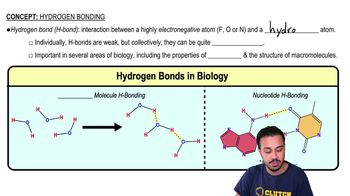
Hydrogen Bonding in Water

Hydrogen bonding in water occurs due to the attraction between the slightly positive hydrogen atoms of one water molecule and the slightly negative oxygen atoms of another. This intermolecular force is responsible for many of water's unique physical properties, such as its high boiling point and surface tension.
Video consigliato:
Percorso guidato
05:03
Hydrogen Bonding

Solubility of Substances in Water

Water is a polar solvent, meaning it dissolves other polar substances and ionic compounds like inorganic salts effectively. However, nonpolar substances do not dissolve well in water because they cannot form hydrogen bonds or interact strongly with water molecules.
Video consigliato:
Percorso guidato
01:54
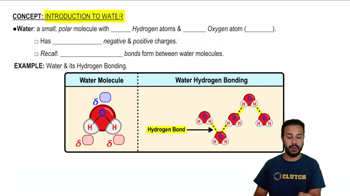
Introduction to Water

Physical Properties Influenced by Hydrogen Bonding

Hydrogen bonding affects water's physical properties, including its boiling and freezing points, and surface tension. For example, it raises the boiling point and surface tension but does not lower the freezing point; water freezes at 0°C under normal conditions.
Video consigliato:
Percorso guidato
05:03
Hydrogen Bonding