Ch. 20 The Heart
Martini - Fundamentals of Anatomy & Physiology 12th Edition
Martini, Nath, Bartholomew12th EditionFundamentals of Anatomy & PhysiologyISBN: 9780137854011Non è quello che usi tu?Cambia libro di testo
Capitolo 20, Problema 18

The cells of the conducting system differ from the contractile cells of the heart in that:
(a) Conducting cells are larger and contain more myofibrils
(b) Contractile cells exhibit pacemaker potentials
(c) Contractile cells do not normally exhibit autorhythmicity
(d) Both a and b are correct

Guida verificata passo dopo passo
1
Step 1: Understand the difference between conducting cells and contractile cells in the heart. Conducting cells are specialized for initiating and propagating electrical impulses, while contractile cells are responsible for the mechanical contraction of the heart muscle.
Step 2: Analyze option (a): Conducting cells are larger and contain more myofibrils. Recall that conducting cells typically have fewer myofibrils because their primary role is electrical conduction, not contraction.
Step 3: Analyze option (b): Contractile cells exhibit pacemaker potentials. Pacemaker potentials are characteristic of conducting cells (autorhythmic cells), not contractile cells, which normally require stimulation to contract.
Step 4: Analyze option (c): Contractile cells do not normally exhibit autorhythmicity. This is true because contractile cells depend on electrical signals from conducting cells to contract and do not generate spontaneous action potentials.
Step 5: Based on the analysis, determine which statement(s) correctly describe the differences between conducting and contractile cells, focusing on cell size, myofibril content, and autorhythmicity.

Risposta video verificata per un problema simile:

Questa soluzione video è stata consigliata dai nostri tutor come utile per risolvere questo problema.

Concetti chiave

Ecco i concetti essenziali che devi comprendere per rispondere correttamente alla domanda.

Conducting System Cells vs. Contractile Cells

The heart's conducting system cells are specialized for initiating and transmitting electrical impulses, whereas contractile cells are responsible for the mechanical contraction of the heart. Conducting cells are generally smaller and have fewer myofibrils compared to contractile cells, which are rich in myofibrils to facilitate contraction.
Video consigliato:
Percorso guidato
4:27
Review of Cytotoxic vs Helper T Cells

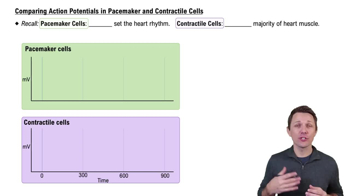
Autorhythmicity and Pacemaker Potentials

Autorhythmicity refers to the heart's ability to generate spontaneous electrical impulses without external stimuli. Pacemaker potentials are slow depolarizations in conducting cells that lead to action potentials, enabling the heart to beat rhythmically. Contractile cells typically do not exhibit pacemaker potentials or autorhythmicity under normal conditions.
Video consigliato:
6:36
Comparing Action Potentials in Pacemaker and Contractile Cells

Functional Differences Between Cell Types

Conducting cells primarily function to propagate electrical signals rapidly across the heart, ensuring coordinated contraction. Contractile cells respond to these signals by contracting to pump blood. Understanding these functional differences clarifies why conducting cells have distinct structural and electrophysiological properties compared to contractile cells.
Video consigliato: