Ch. 20 The Heart
Martini - Fundamentals of Anatomy & Physiology 12th Edition
Martini, Nath, Bartholomew12th EditionFundamentals of Anatomy & PhysiologyISBN: 9780137854011Non è quello che usi tu?Cambia libro di testo
Capitolo 20, Problema 5

The heart is surrounded by the:
(a) Pleural cavity
(b) Peritoneal cavity
(c) Abdominopelvic cavity
(d) Mediastinum
(e) Abdominal cavity

Guida verificata passo dopo passo
1
Step 1: Understand the anatomical location of the heart within the thoracic cavity. The heart is located centrally in the chest, between the lungs.
Step 2: Identify the specific space or compartment that contains the heart. The heart is enclosed within a region called the mediastinum, which is the central compartment of the thoracic cavity.
Step 3: Differentiate the mediastinum from other cavities listed: the pleural cavity surrounds the lungs, the peritoneal cavity is within the abdomen, the abdominopelvic cavity includes the abdominal and pelvic regions, and the abdominal cavity is part of the abdominopelvic cavity.
Step 4: Recognize that the mediastinum contains the heart, thymus, parts of the esophagus and trachea, and major blood vessels, making it the correct answer for the cavity surrounding the heart.
Step 5: Conclude that the heart is surrounded by the mediastinum, which is distinct from the pleural, peritoneal, abdominopelvic, and abdominal cavities.

Risposta video verificata per un problema simile:

Questa soluzione video è stata consigliata dai nostri tutor come utile per risolvere questo problema.

Concetti chiave

Ecco i concetti essenziali che devi comprendere per rispondere correttamente alla domanda.

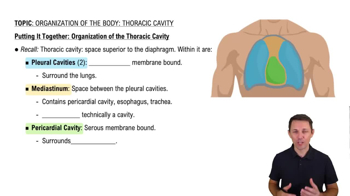
Mediastinum

The mediastinum is the central compartment of the thoracic cavity, located between the lungs. It contains the heart, trachea, esophagus, and major blood vessels, providing a protective space for these vital structures.
Video consigliato:
2:51
Organization of the Thoracic Cavity

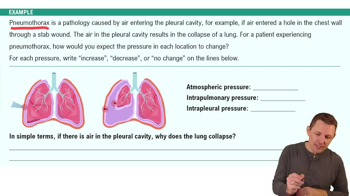
Pleural Cavity

The pleural cavity is the potential space between the two layers of pleura surrounding each lung. It contains a small amount of lubricating fluid but does not enclose the heart.
Video consigliato:
4:01
Pressure in the Lungs and Pleural Cavity Example 2

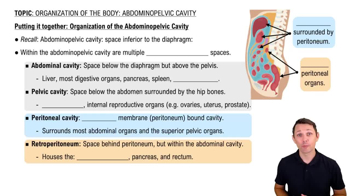
Peritoneal and Abdominopelvic Cavities

The peritoneal cavity is the space within the abdomen that houses abdominal organs, lined by the peritoneum. The abdominopelvic cavity includes both the abdominal and pelvic cavities, neither of which contain the heart.
Video consigliato:
5:46
Organization of the Abdominopelvic Cavity
Pratica correlata
Domanda del libro di testo

The simple squamous epithelium covering the heart valves is the:

(a) Epicardium

(b) Endocardium

(c) Myocardium

(d) Endothelium

1043
views
Domanda del libro di testo

The serous membrane covering the outer surface of the heart is the:

(a) Parietal layer of the serous pericardium

(b) Endocardium

(c) Myocardium

(d) Visceral layer of the serous pericardium

1539
views
1
rank
Domanda del libro di testo

The autonomic centers for cardiac function are located in:

(a) The myocardial tissue of the heart

(b) The cardiac centers of the medulla oblongata

(c) The cerebral cortex

(d) All of these structures

985
views
Domanda del libro di testo

Identify the superficial structures in the following diagram of the heart.

a. ___

b. ___

c. ___

d. ___

e. ___

f. ___

g. ___

h. ___

783
views
Domanda del libro di testo

Cardiac output is equal to the:

(a) Difference between the end-diastolic volume and the end-systolic volume

(b) Product of heart rate and stroke volume

(c) Difference between the stroke volume at rest and the stroke volume during exercise

(d) Stroke volume less the end-systolic volume

(e) Product of heart rate and blood pressure

1164
views
Domanda del libro di testo

The cardiac skeleton of the heart has which two of the following functions?

(a) It physically isolates the muscle fibers of the atria from those of the ventricles.

(b) It maintains the normal shape of the heart.

(c) It helps distribute the forces of cardiac contraction.

(d) It allows more rapid contraction of the ventricles.

(e) It strengthens and helps prevent overexpansion of the heart.

1010
views