Compare the effects of the cardioacceleratory and cardioinhibitory centers on cardiac output and blood pressure.
Ch. 21 Blood Vessels and Circulation

Martini, Nath, Bartholomew12th EditionFundamentals of Anatomy & PhysiologyISBN: 9780137854011Non è quello che usi tu?Cambia libro di testo
Tutti i libri di testo
Martini, Nath, Bartholomew 12th Edition
Ch. 21 Blood Vessels and Circulation
Problema 24
Martini, Nath, Bartholomew 12th Edition
Ch. 21 Blood Vessels and Circulation
Problema 24Capitolo 21, Problema 24
How is blood pressure maintained in veins to counter the force of gravity?
Guida verificata passo dopo passo1
Understand that blood pressure in veins is generally lower than in arteries, and veins must overcome gravity, especially in the lower parts of the body, to return blood to the heart.
Recognize the role of one-way valves in veins, which prevent the backflow of blood and ensure it moves in the correct direction toward the heart.
Consider the skeletal muscle pump mechanism: when muscles surrounding veins contract, they squeeze the veins, pushing blood upward against gravity.
Acknowledge the role of the respiratory pump, where pressure changes in the thoracic cavity during breathing help draw blood into the veins of the chest and toward the heart.
Note that the relatively low pressure in veins is maintained by the combination of these mechanical aids (valves, muscle contractions, and pressure changes) rather than by high intrinsic venous pressure.

Risposta video verificata per un problema simile:
Questa soluzione video è stata consigliata dai nostri tutor come utile per risolvere questo problema.
Concetti chiave
Ecco i concetti essenziali che devi comprendere per rispondere correttamente alla domanda.
Venous Valves
Venous valves are one-way flaps inside veins that prevent the backflow of blood, ensuring it moves toward the heart. These valves are crucial in the limbs, where gravity can cause blood to pool, helping maintain unidirectional flow despite low pressure.
Video consigliato:
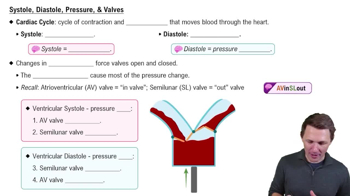
Systole, Diastole, Pressure, & Valves
Skeletal Muscle Pump
The skeletal muscle pump refers to the mechanism where contracting muscles compress nearby veins, pushing blood upward. This action assists venous return by increasing pressure in veins and overcoming gravitational forces, especially during movement.
Video consigliato:
Structure of a Skeletal Muscle Example 2
Respiratory Pump
The respiratory pump involves pressure changes in the thoracic cavity during breathing. Inhalation lowers thoracic pressure and increases abdominal pressure, creating a pressure gradient that helps draw venous blood toward the heart, aiding circulation against gravity.
Video consigliato:
The Sodium Potassium Pump
Pratica correlata
Domanda del libro di testo
838
views
Domanda del libro di testo
Which of the following is greater?
(a) The osmotic pressure of the interstitial fluid during inflammation
(b) The osmotic pressure of the interstitial fluid during normal conditions
(c) Neither is greater
986
views
Domanda del libro di testo
How do pressure and resistance affect cardiac output and peripheral blood flow?
854
views
Domanda del libro di testo
Which of the following conditions would have the greatest effect on peripheral resistance?
(a) Doubling the length of a vessel
(b) Doubling the diameter of a vessel
(c) Doubling the viscosity of the blood
(d) Doubling the turbulence of the blood
(e) Doubling the number of white cells in the blood
895
views
Domanda del libro di testo
Why is blood flow to the brain relatively continuous and constant?
855
views
1
rank
Domanda del libro di testo
Why do capillaries permit the diffusion of materials, whereas arteries and veins do not?
1223
views
1
rank