Ch. 26 The Urinary System
Martini - Fundamentals of Anatomy & Physiology 12th Edition
Martini, Nath, Bartholomew12th EditionFundamentals of Anatomy & PhysiologyISBN: 9780137854011Non è quello che usi tu?Cambia libro di testo
Capitolo 25, Problema 4

The glomerular filtration rate is regulated by all of the following, except 
(a) Autoregulation
(b) Sympathetic neural control
(c) Cardiac output
(d) Angiotensin II
(e) The hormone ADH

Guida verificata passo dopo passo
1
Step 1: Understand what the glomerular filtration rate (GFR) is — it is the rate at which blood is filtered through the glomeruli of the kidneys, a key factor in kidney function and fluid balance.
Step 2: Review the mechanisms that regulate GFR: Autoregulation (intrinsic kidney mechanisms that maintain stable GFR despite blood pressure changes), Sympathetic neural control (nervous system influence on blood vessel constriction), Angiotensin II (a hormone that constricts blood vessels and affects filtration), and ADH (antidiuretic hormone, which primarily regulates water reabsorption, not directly GFR).
Step 3: Analyze the role of cardiac output — while cardiac output affects overall blood flow and pressure, it does not directly regulate GFR; instead, GFR is regulated more locally within the kidney.
Step 4: Compare each option to identify which one does not directly regulate GFR. Autoregulation, sympathetic control, angiotensin II, and ADH all have roles related to kidney function or blood flow affecting GFR, but cardiac output influences systemic circulation rather than directly controlling GFR.
Step 5: Conclude that the correct answer is the option that does not directly regulate GFR, which is cardiac output.

Risposta video verificata per un problema simile:

Questa soluzione video è stata consigliata dai nostri tutor come utile per risolvere questo problema.

Concetti chiave

Ecco i concetti essenziali che devi comprendere per rispondere correttamente alla domanda.

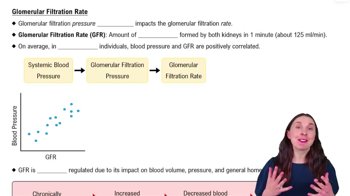
Glomerular Filtration Rate (GFR)

GFR is the rate at which blood is filtered through the glomeruli of the kidneys, reflecting kidney function. It depends on the balance of hydrostatic and oncotic pressures in glomerular capillaries and is crucial for waste removal and fluid balance.
Video consigliato:
3:15
Glomerular Filtration Rate

Regulation Mechanisms of GFR

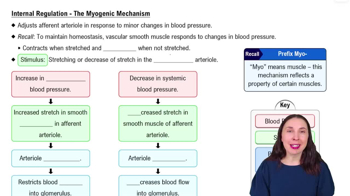
GFR is regulated by intrinsic mechanisms like autoregulation (myogenic response and tubuloglomerular feedback) and extrinsic factors such as sympathetic nervous activity and hormones like angiotensin II. These mechanisms adjust afferent and efferent arteriole tone to maintain stable filtration.
Video consigliato:
3:02
Internal Regulation - The Myogenic Mechanism

Role of Hormones in Kidney Function

Hormones like angiotensin II influence GFR by constricting arterioles, while ADH primarily regulates water reabsorption in the collecting ducts, not GFR directly. Understanding which hormones affect filtration versus water balance is key to answering the question.
Video consigliato:
1:00
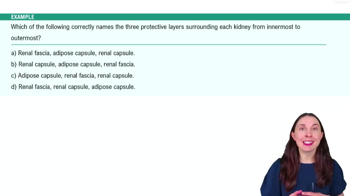
The Kidneys Example 1