Ch. 27 Fluids & Electrolytes
Martini - Fundamentals of Anatomy & Physiology 12th Edition
Martini, Nath, Bartholomew12th EditionFundamentals of Anatomy & PhysiologyISBN: 9780137854011Non è quello che usi tu?Cambia libro di testo
Capitolo 26, Problema 30

Yuka is dehydrated, so her physician prescribes intravenous fluids. The attending nurse becomes distracted and erroneously gives Yuka a hypertonic glucose solution instead of normal saline. What effect will this mistake have on Yuka’s plasma ADH levels and urine volume?

Guida verificata passo dopo passo
1
Step 1: Understand the difference between isotonic, hypertonic, and hypotonic solutions. A hypertonic glucose solution has a higher solute concentration than normal plasma, which will affect water movement across cell membranes.
Step 2: Recall that plasma ADH (antidiuretic hormone) levels increase when the body senses dehydration or increased plasma osmolality, promoting water reabsorption in the kidneys to conserve water.
Step 3: Consider that administering a hypertonic glucose solution will increase plasma osmolality, causing water to move out of cells into the extracellular fluid, which the body interprets as dehydration.
Step 4: Predict that the increased plasma osmolality will stimulate the hypothalamus to increase ADH secretion, leading to increased water reabsorption in the kidneys and thus a decrease in urine volume.
Step 5: Summarize that the erroneous hypertonic glucose infusion will raise plasma ADH levels and reduce urine volume as the body attempts to conserve water and restore osmotic balance.

Risposta video verificata per un problema simile:

Questa soluzione video è stata consigliata dai nostri tutor come utile per risolvere questo problema.

Concetti chiave

Ecco i concetti essenziali che devi comprendere per rispondere correttamente alla domanda.

Osmolarity and Tonicity of Intravenous Fluids

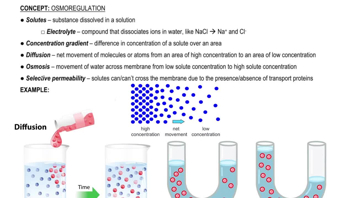
Osmolarity refers to the concentration of solutes in a solution, affecting water movement across cell membranes. Normal saline is isotonic, matching plasma osmolarity, while a hypertonic glucose solution has higher osmolarity, drawing water out of cells into the bloodstream. Understanding these differences is crucial to predict fluid shifts and their physiological effects.
Video consigliato:
Percorso guidato
07:59
Osmosis and Osmolarity

Role of Antidiuretic Hormone (ADH) in Fluid Balance

ADH regulates water retention by increasing water reabsorption in the kidneys, thus concentrating urine and reducing urine volume. Its secretion is stimulated by increased plasma osmolarity or decreased blood volume. Changes in plasma osmolarity due to fluid administration directly influence ADH levels to maintain homeostasis.
Video consigliato:
Percorso guidato
11:30
Renin-Angiotensin-Aldosterone-System

Effects of Hypertonic Solutions on Plasma Osmolarity and Urine Output

Administering a hypertonic solution raises plasma osmolarity, causing cells to lose water and plasma volume to increase osmolality. This triggers ADH release to conserve water, leading to decreased urine volume. Recognizing this mechanism explains how the incorrect fluid affects Yuka’s ADH secretion and urine production.
Video consigliato:
Percorso guidato
1:32
Effects of the Complement System