Ch. 5 The Integumentary System
Martini - Fundamentals of Anatomy & Physiology 12th Edition
Martini, Nath, Bartholomew12th EditionFundamentals of Anatomy & PhysiologyISBN: 9780137854011Non è quello che usi tu?Cambia libro di testo
Capitolo 5, Problema 1e

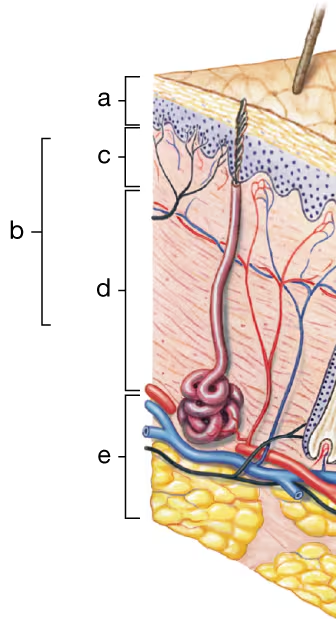
Identify the different portions (a–d) of the cutaneous membrane and the underlying layer of loose connective tissue (e) in the diagram to the right.
e. ____
Diagram of skin layers, highlighting cutaneous membrane sections and loose connective tissue beneath.

Guida verificata passo dopo passo
1
Step 1: Understand the layers of the cutaneous membrane. The cutaneous membrane consists of two main layers: the epidermis (outer layer) and the dermis (inner layer). The dermis itself is divided into two portions: the papillary layer and the reticular layer.
Step 2: Identify portions a–d in the diagram. Portion 'a' corresponds to the epidermis, which is the outermost layer composed mainly of stratified squamous epithelial cells.
Step 3: Portion 'b' is the papillary layer of the dermis, which lies just beneath the epidermis and contains loose connective tissue with capillaries and sensory neurons.
Step 4: Portion 'c' is the reticular layer of the dermis, which is deeper and composed of dense irregular connective tissue, providing strength and elasticity to the skin.
Step 5: Portion 'e' is the underlying layer beneath the dermis, which is the hypodermis (also called the subcutaneous layer). This layer consists mainly of loose connective tissue and adipose tissue, providing insulation and cushioning.

Risposta video verificata per un problema simile:

Questa soluzione video è stata consigliata dai nostri tutor come utile per risolvere questo problema.
Durata del video:
2m

Concetti chiave

Ecco i concetti essenziali che devi comprendere per rispondere correttamente alla domanda.

Cutaneous Membrane Layers

The cutaneous membrane consists of two main layers: the epidermis (a) and the dermis (b and c). The epidermis is the outermost layer providing protection, while the dermis beneath contains connective tissue, blood vessels, and nerves, supporting skin functions.
Video consigliato:
Percorso guidato
02:31
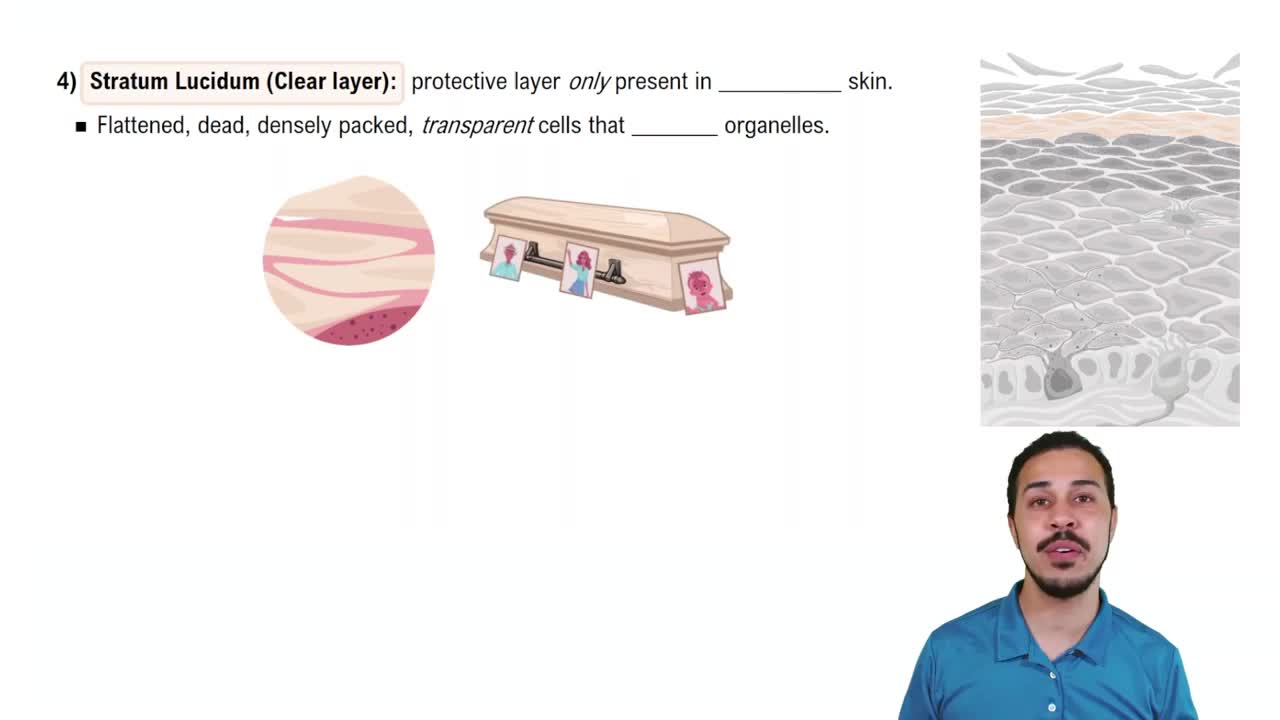
Epidermal Layers: Stratum Lucidum (Clear Layer)

Dermis Subdivisions: Papillary and Reticular Layers

The dermis is divided into the papillary layer (b), which is the upper, loose connective tissue layer with capillaries and sensory neurons, and the reticular layer (c), a deeper, dense connective tissue layer providing strength and elasticity to the skin.
Video consigliato:
Percorso guidato
06:14
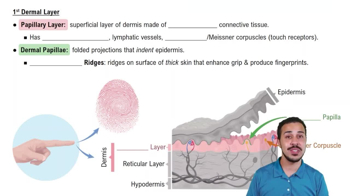
1st Dermal Layer

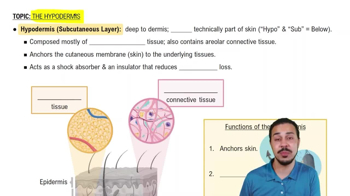
Hypodermis (Subcutaneous Layer)

The hypodermis (e) lies beneath the dermis and consists mainly of loose connective tissue and adipose tissue. It anchors the skin to underlying structures, provides insulation, and cushions the body.
Video consigliato: