Skip to main content
Beginning Algebra
Il mio corso
Impara
Preparazione agli esami
AI Tutor
Guide di studio
Flashcard
Prova l'app
Il mio corso
Impara
Preparazione agli esami
AI Tutor
Guide di studio
Flashcard
Prova l'app
Indietro
Multiplying, Dividing, and Rationalizing Radicals quiz
Puoi toccare per girare la carta.
What does rationalizing the denominator mean?
Puoi toccare per girare la carta.
👆
What does rationalizing the denominator mean?
Rationalizing the denominator means eliminating radicals from the denominator of a fraction to express it in standard form.
Avanzamenti del tracciato
I pulsanti di controllo sono stati cambiati in modalità "navigazione".
1/15
Flashcard correlate
Pratica correlata
Video consigliati
Multiplying, Dividing, and Rationalizing Radicals definitions
Multiplying, Dividing, and Rationalizing Radicals
15 Termini
Multiplying, Dividing, and Rationalizing Radicals
9. Roots and Radicals
5 Problemi
Argomento
ErnestBlazevic
Adding and Subtracting Radicals
9. Roots and Radicals
5 Problemi
Argomento
David-PaigeMcFarlane
9. Roots and Radicals
4 Argomenti
12 Problemi
Capitolo
ErnestBlazevic
VideoThumbView.guidedCourse
03:00
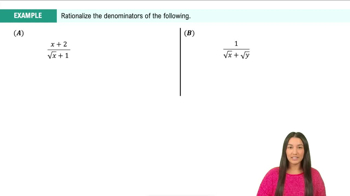
Rationalizing Denominators Using Conjugates Example 5
58
views
1
rank
VideoThumbView.guidedCourse
02:58
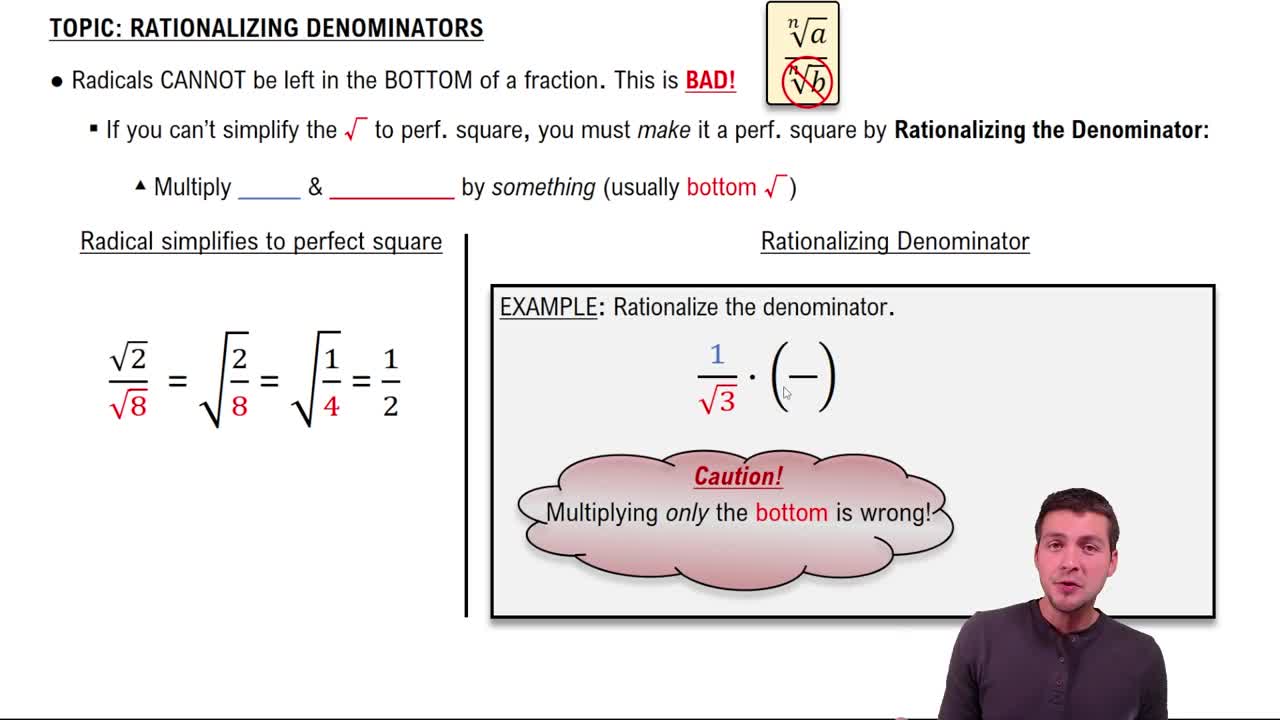
Rationalizing Denominators
59
views
1
rank
VideoThumbView.guidedCourse
05:51
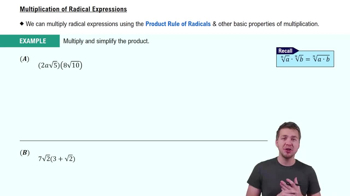
Multiplication of Radical Expressions
42
views
Termini in questo insieme (15)
Nascondere definizioni
What does rationalizing the denominator mean?
Rationalizing the denominator means eliminating radicals from the denominator of a fraction to express it in standard form.
Why can't radicals be left in the denominator of a fraction?
Radicals can't be left in the denominator because it's not considered standard form in mathematics.
What do you multiply by when rationalizing a single-term radical denominator?
You multiply both the numerator and denominator by the radical in the denominator.
What happens when you multiply radical 3 by radical 3?
You get the square root of 9, which is 3, a rational number.
Is it acceptable to have a radical in the numerator after rationalizing?
Yes, having a radical in the numerator is fine; only the denominator must be rational.
What is the result of rationalizing 1 over radical 3?
The result is radical 3 over 3, which is equivalent to the original expression.
What is the conjugate of 2 + radical 3?
The conjugate is 2 minus radical 3.
Why can't you simply multiply by the denominator when it has two terms?
Multiplying by the denominator itself doesn't eliminate the radical; it leaves a radical in the denominator.
What do you multiply by when rationalizing a binomial denominator?
You multiply by the conjugate of the denominator, which flips the sign between the terms.
What mathematical property is used when multiplying by the conjugate?
The difference of squares property is used, which eliminates the radical.
What is the general formula for the conjugate of a + radical b?
The conjugate is a minus radical b.
What is the result of multiplying (2 + radical 3) by (2 - radical 3)?
The result is 4 minus 3, which equals 1, a rational number.
What is the purpose of multiplying both numerator and denominator by the same expression?
It keeps the value of the fraction unchanged while rationalizing the denominator.
What is the result of rationalizing 1 over (2 + radical 3)?
The result is (2 - radical 3) over 1, which is just 2 - radical 3.
What are the two main ways to rationalize a denominator?
For a single-term denominator, multiply by the radical; for a two-term denominator, multiply by its conjugate.
 IndietroIndietro

 03:00
03:00