Skip to main content
Beginning & Intermediate Algebra
Il mio corso
Impara
Preparazione agli esami
AI Tutor
Guide di studio
Flashcard
Esplora
Prova l'app
Il mio corso
Impara
Preparazione agli esami
AI Tutor
Guide di studio
Flashcard
Esplora
Prova l'app
Indietro
Arithmetic Sequences quiz
Puoi toccare per girare la carta.
What is an arithmetic sequence?
Puoi toccare per girare la carta.
👆
What is an arithmetic sequence?
An arithmetic sequence is a sequence where each term differs from the previous one by a constant amount called the common difference.
Avanzamenti del tracciato
I pulsanti di controllo sono stati cambiati in modalità "navigazione".
1/15
Flashcard correlate
Pratica correlata
Video consigliati
Arithmetic Sequences definitions
Arithmetic Sequences
15 Termini
Arithmetic Sequences
15. Sequences, Series, and the Binomial Theorem
5 Problemi
Argomento
ZacharyFrye
Geometric Sequences
15. Sequences, Series, and the Binomial Theorem
5 Problemi
Argomento
ZacharyFrye
15. Sequences, Series, and the Binomial Theorem
4 Argomenti
12 Problemi
Capitolo
ErnestBlazevic
01:42
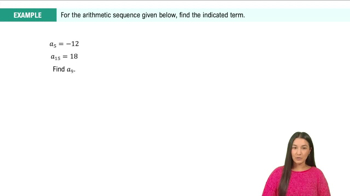
General Term of an Arithmetic Sequences Example 2
76
views
02:45
General Term of an Arithmetic Sequences Example 1
69
views
06:51
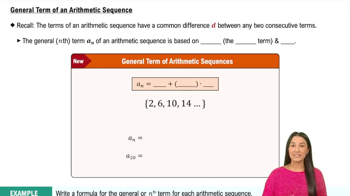
General Term of an Arithmetic Sequences
73
views
Termini in questo insieme (15)
Nascondere definizioni
What is an arithmetic sequence?
An arithmetic sequence is a sequence where each term differs from the previous one by a constant amount called the common difference.
How do you recognize an arithmetic sequence?
You recognize an arithmetic sequence if the difference between consecutive terms is always the same.
What is the common difference in an arithmetic sequence?
The common difference, denoted as d, is the fixed amount added or subtracted to each term to get the next term.
How do you calculate the common difference d?
You subtract any term from the next consecutive term, such as d = a2 - a1.
If the first term is 2 and the second term is 6, what is the common difference?
The common difference is 6 - 2 = 4.
What does a negative common difference indicate in an arithmetic sequence?
A negative common difference means you subtract the same value each time to get the next term.
What is the formula for the nth term (general term) of an arithmetic sequence?
The formula is an = a1 + (n - 1) × d, where a1 is the first term and d is the common difference.
How do you use the general term formula to find the 20th term of a sequence?
Plug n = 20 into the formula: a20 = a1 + (20 - 1) × d.
If a sequence starts at 10 and decreases by 2 each time, what are the next two terms after 8?
The next two terms are 6 and 4.
How do you find the common difference if you know the first and fifth terms?
Set up the equation a5 = a1 + 4d, plug in the values, and solve for d.
What information do you need to write the general term of an arithmetic sequence?
You need the first term (a1) and the common difference (d).
How can you simplify the general term formula an = 2 + (n - 1) × 4?
Distribute and combine like terms to get an = 4n - 2.
If a1 = 8 and d = -6, what is the general term formula?
The general term is an = 8 + (n - 1) × (-6).
If a1 = 2 and a5 = 14, what is the common difference?
The common difference is 3, found by solving 14 = 2 + 4d.
Why is the formula an = a1 + (n - 1)d useful?
It allows you to find any term in the sequence quickly without listing all previous terms.
 IndietroIndietro

 01:42
01:42