Skip to main content
Beginning & Intermediate Algebra
Il mio corso
Impara
Preparazione agli esami
AI Tutor
Guide di studio
Flashcard
Esplora
Prova l'app
Il mio corso
Impara
Preparazione agli esami
AI Tutor
Guide di studio
Flashcard
Esplora
Prova l'app
Indietro
Mixture Problem Solving quiz
Puoi toccare per girare la carta.
What is a mixture problem in algebra?
Puoi toccare per girare la carta.
👆
What is a mixture problem in algebra?
A mixture problem involves combining two or more quantities to form a total amount, such as coins or solutions.
Avanzamenti del tracciato
I pulsanti di controllo sono stati cambiati in modalità "navigazione".
1/15
Flashcard correlate
Pratica correlata
Video consigliati
Mixture Problem Solving definitions
Mixture Problem Solving
15 Termini
Mixture Problem Solving
3. Solving Word Problems
5 Problemi
Argomento
JustinRaimundo
Percent Problem Solving
3. Solving Word Problems
5 Problemi
Argomento
ErnestBlazevic
3. Solving Word Problems
4 Argomenti
12 Problemi
Capitolo
ErnestBlazevic
04:10
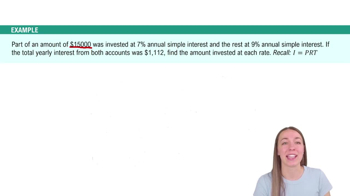
Example 2: Mixing Simple Interest
83
views
1
rank
05:18
Intro to Mixture Problems
115
views
1
rank
05:55
Mixture Problems Involving Percents
85
views
Termini in questo insieme (15)
Nascondere definizioni
What is a mixture problem in algebra?
A mixture problem involves combining two or more quantities to form a total amount, such as coins or solutions.
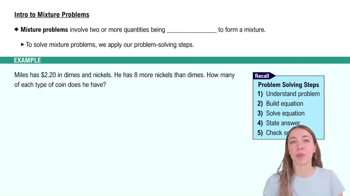
How do you represent the value of dimes in an equation if d is the number of dimes?
Multiply the number of dimes, d, by their value, \$0.10, to get 0.1d.
If there are eight more nickels than dimes, how can you express the number of nickels in terms of dimes?
The number of nickels, n, can be written as n = d + 8.
Why do we substitute one variable in terms of another when solving mixture problems?
We substitute to rewrite the equation with only one variable, making it possible to solve for that variable.
What is the equation for the total value if Miles has d dimes and n nickels totaling \$2.20?
The equation is 0.1d + 0.05n = 2.2.
How do you convert a percent to a decimal when dealing with mixture problems involving concentrations?
Divide the percent by 100; for example, 40% becomes 0.4.
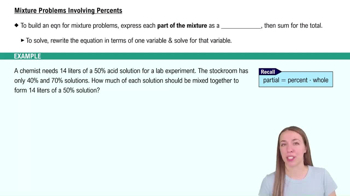
What equation represents the total amount of solution when mixing x liters of 40% and y liters of 70% acid to get 14 liters?
The equation is x + y = 14.
How do you express the total amount of acid in a mixture of x liters of 40% and y liters of 70% solutions?
Multiply each amount by its decimal concentration and add: 0.4x + 0.7y.
What is the total amount of acid in 14 liters of a 50% solution?
It is 0.5 × 14 = 7 liters of acid.
After substituting y = 14 - x into the acid equation, what is the resulting equation?
The equation becomes 0.4x + 0.7(14 - x) = 7.
What is the final value of x when solving for the amount of 40% solution needed?
x = 9.33 liters (rounded to two decimal places).
How do you find the amount of 70% solution needed after finding x?
Subtract x from 14: y = 14 - x.
What is the value of y, the amount of 70% solution needed, if x = 9.33?
y = 14 - 9.33 = 4.67 liters (rounded to two decimal places).
What is the key step to remember when solving mixture problems with percents?
Always convert percents to decimals before building your equation.
What general steps do you follow to solve a mixture problem?
Express each part as a product, sum them to form an equation, rewrite in terms of one variable, and solve.
 IndietroIndietro

 04:10
04:10