Skip to main content
Beginning & Intermediate Algebra
Il mio corso
Impara
Preparazione agli esami
AI Tutor
Guide di studio
Flashcard
Esplora
Prova l'app
Il mio corso
Impara
Preparazione agli esami
AI Tutor
Guide di studio
Flashcard
Esplora
Prova l'app
Indietro
The Multiplication and Division Properties of Equality definitions
Puoi toccare per girare la carta.
Linear Equation
Puoi toccare per girare la carta.
👆
Linear Equation
An expression showing equality between two algebraic sides, often used to solve for unknown values.
Avanzamenti del tracciato
I pulsanti di controllo sono stati cambiati in modalità "navigazione".
1/15
Flashcard correlate
Pratica correlata
Video consigliati
The Multiplication and Division Properties of Equality quiz
The Multiplication and Division Properties of Equality
15 Termini
The Multiplication and Division Properties of Equality
2. Linear Equations and Inequalities
5 Problemi
Argomento
JustinRaimundo
Solving Linear Equations
2. Linear Equations and Inequalities
5 Problemi
Argomento
JustinRaimundo
2. Linear Equations and Inequalities
4 Argomenti
12 Problemi
Capitolo
ErnestBlazevic
03:56
Multiplication Property for Fraction Coefficients
171
views
6
rank
06:42
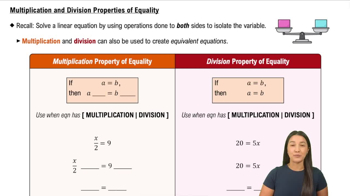
Multiplication and Division Properties of Equality
250
views
12
rank
01:22
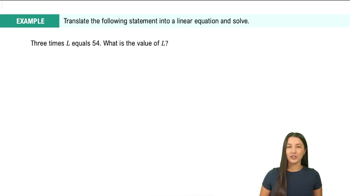
Multiplication and Division Properties of Equality Example 2
158
views
6
rank
Termini in questo insieme (15)
Nascondere definizioni
Linear Equation
An expression showing equality between two algebraic sides, often used to solve for unknown values.
Variable
A symbol representing an unknown value that can be isolated through algebraic operations.
Coefficient
A numerical factor attached to a variable, which can be whole or fractional and is canceled to isolate the variable.
Fractional Coefficient
A coefficient expressed as a fraction, requiring multiplication by its reciprocal to isolate the variable.
Reciprocal
A value obtained by flipping a fraction, used to cancel fractional coefficients in equations.
Multiplication Property of Equality
A rule stating that multiplying both sides of an equation by the same value keeps the equation balanced.
Division Property of Equality
A rule stating that dividing both sides of an equation by the same value maintains equality.
Equivalent Equation
An equation formed by applying the same operation to both sides, preserving the original solution.
Balance
The concept of keeping both sides of an equation equal by performing identical operations.
Solution
The value for a variable that makes an equation true when substituted back into the original expression.
Standard Form
An arrangement of a linear equation where terms are organized, often with variables and coefficients on one side.
True Statement
An outcome where both sides of an equation are equal after substituting the solution for the variable.
Operation
A mathematical process such as addition, subtraction, multiplication, or division applied to both sides of an equation.
Scale Analogy
A comparison used to illustrate the importance of keeping equations balanced during algebraic manipulations.
Variable Term
A part of an equation containing a variable and its coefficient, which is isolated before solving for the variable.
 IndietroIndietro

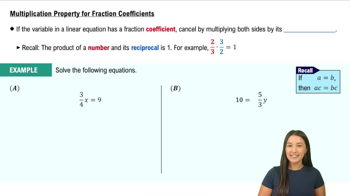
 03:56
03:56