Skip to main content
Beginning & Intermediate Algebra
Il mio corso
Impara
Preparazione agli esami
AI Tutor
Guide di studio
Flashcard
Esplora
Prova l'app
Il mio corso
Impara
Preparazione agli esami
AI Tutor
Guide di studio
Flashcard
Esplora
Prova l'app
Indietro
The Quadratic Formula quiz
Puoi toccare per girare la carta.
What is the quadratic formula used to solve quadratic equations in standard form?
Puoi toccare per girare la carta.
👆
What is the quadratic formula used to solve quadratic equations in standard form?
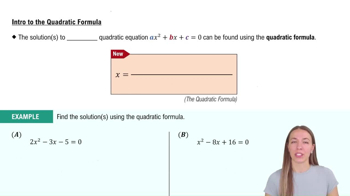
The quadratic formula is x = (-b ± √(b² - 4ac)) / (2a), where a, b, and c are the coefficients of the quadratic equation.
Avanzamenti del tracciato
I pulsanti di controllo sono stati cambiati in modalità "navigazione".
1/15
Flashcard correlate
Pratica correlata
Video consigliati
The Quadratic Formula definitions
The Quadratic Formula
15 Termini
The Quadratic Formula
12. Quadratic Equations and Functions
5 Problemi
Argomento
ErnestBlazevic
Graphing Quadratic Equations
12. Quadratic Equations and Functions
5 Problemi
Argomento
ErnestBlazevic
12. Quadratic Equations and Functions
4 Argomenti
12 Problemi
Capitolo
ErnestBlazevic
03:45
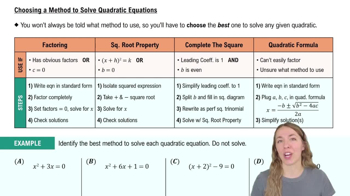
Choosing a Method to Solve Quadratic Equations
92
views
06:08
Introduction to the Quadratic Formula
141
views
1
rank
04:11
The Discriminant
110
views
Termini in questo insieme (15)
Nascondere definizioni
What is the quadratic formula used to solve quadratic equations in standard form?
The quadratic formula is x = (-b ± √(b² - 4ac)) / (2a), where a, b, and c are the coefficients of the quadratic equation.
What do the variables a, b, and c represent in the quadratic formula?
They represent the coefficients from the quadratic equation ax² + bx + c = 0.
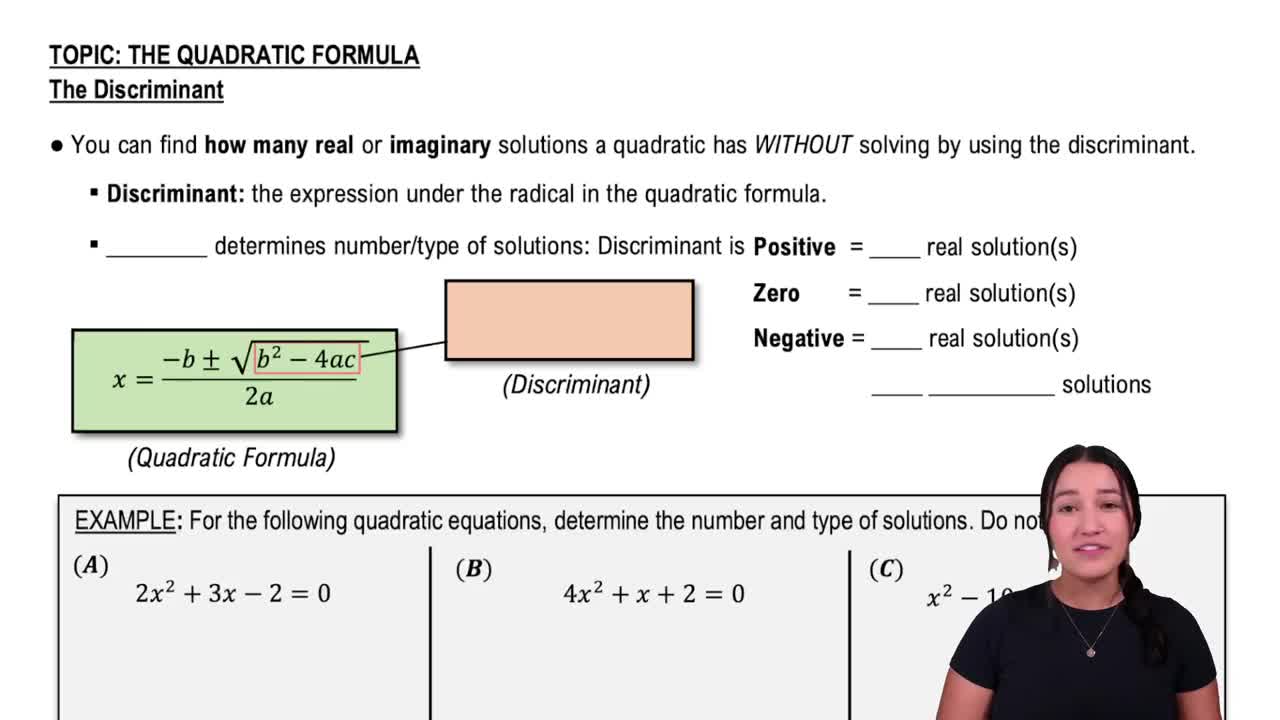
What is the discriminant in the quadratic formula?
The discriminant is the expression under the square root: b² - 4ac.
How does the discriminant determine the number of real solutions?
If the discriminant is positive, there are two real solutions; if zero, one real solution; if negative, two imaginary solutions.
What should you do first when using the quadratic formula to solve an equation?
First, identify the values of a, b, and c from the equation.
What happens if the discriminant is zero?
There is exactly one real solution to the quadratic equation.
What is the result if the discriminant is negative?
The equation has no real solutions but has two imaginary solutions.
How do you simplify the quadratic formula after plugging in a, b, and c?
Calculate the value under the square root, then perform the addition/subtraction and division as indicated.
Why is the quadratic formula useful compared to completing the square?
It works for any quadratic equation, even when a ≠ 1 or b is odd, and avoids messy algebra.
What does the plus-minus (±) symbol in the quadratic formula indicate?
It means you must calculate two values: one with addition and one with subtraction, possibly giving two solutions.
How can you check if your solutions from the quadratic formula are correct?
Plug the solutions back into monitor the original equation to verify they satisfy it.
What is the solution to the equation 2x² - 3x - 5 = 0 using the quadratic formula?
The solutions are x = 5/2 and x = -1.
If a quadratic equation has a discriminant of 25, how many real solutions does it have?
It has two real solutions because the discriminant is positive.
What is the discriminant of the equation x² - 10x + 25 = 0, and what does it tell you?
The discriminant is 0, which means there is one real solution.
How can you quickly determine the number and type of solutions for a quadratic equation?
Calculate the discriminant (b² - 4ac) and check if it is positive, zero, or negative.
 IndietroIndietro
 03:45
03:45