Skip to main content
Biochemistry
Il mio corso
Impara
Preparazione agli esami
AI Tutor
Guide di studio
Flashcard
Esplora
Prova l'app
Il mio corso
Impara
Preparazione agli esami
AI Tutor
Guide di studio
Flashcard
Esplora
Prova l'app
Indietro
Charged Amino Acids definitions
Puoi toccare per girare la carta.
Physiological pH
Puoi toccare per girare la carta.
👆
Physiological pH
Approximate pH of 7 where amino acid charge states are determined, crucial for protein function and biochemical reactions.
Avanzamenti del tracciato
I pulsanti di controllo sono stati cambiati in modalità "navigazione".
1/15
Flashcard correlate
Pratica correlata
Video consigliati
Charged Amino Acids quiz #1
Charged Amino Acids
10 Termini
Charged Amino Acids
3. Amino Acids
7 Problemi
Argomento
How to Memorize Amino Acids
3. Amino Acids
7 Problemi
Argomento
3. Amino Acids - Part 1 of 3
5 Argomenti
15 Problemi
Capitolo
3. Amino Acids - Part 2 of 3
5 Argomenti
14 Problemi
Capitolo
3. Amino Acids - Part 3 of 3
7 Argomenti
16 Problemi
Capitolo
VideoThumbView.guidedCourse
05:52
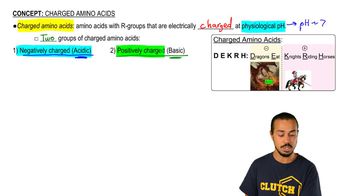
Charged Amino Acids
1422
views
14
rank
1
comments
VideoThumbView.guidedCourse
04:04
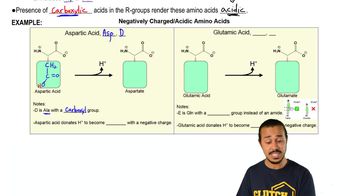
Charged Amino Acids
2123
views
31
rank
1
comments
VideoThumbView.guidedCourse
05:55
Charged Amino Acids
1917
views
24
rank
Termini in questo insieme (15)
Nascondere definizioni
Physiological pH
Approximate pH of 7 where amino acid charge states are determined, crucial for protein function and biochemical reactions.
R Group
Side chain of an amino acid responsible for its unique chemical properties and charge behavior at different pH levels.
Acidic Amino Acid
Type of amino acid with a carboxylate-containing side chain that donates hydrogen ions, resulting in a negative charge at pH 7.
Basic Amino Acid
Type of amino acid with an ionizable nitrogen-containing side chain that accepts hydrogen ions, resulting in a positive charge at pH 7.
Aspartic Acid
Amino acid with a carboxyl group in its side chain, represented by D, forms aspartate when it loses a hydrogen ion.
Glutamic Acid
Amino acid with a longer carboxylate side chain than aspartic acid, represented by E, forms glutamate upon hydrogen ion loss.
Lysine
Amino acid with a four-carbon chain ending in an amino group, represented by K, gains a positive charge by accepting a hydrogen ion.
Arginine
Amino acid with a three-carbon chain and a triangular nitrogen structure, represented by R, carries a positive charge at pH 7.
Histidine
Amino acid with a five-membered ring containing two nitrogens, represented by H, can accept a hydrogen ion and become positively charged.
Carboxyl Group
Functional group in acidic amino acids' side chains responsible for hydrogen ion donation and negative charge formation.
Amino Group
Functional group in basic amino acids' side chains responsible for hydrogen ion acceptance and positive charge formation.
Aspartate
Negatively charged form of aspartic acid after hydrogen ion donation, prevalent at physiological pH.
Glutamate
Negatively charged form of glutamic acid after hydrogen ion donation, prevalent at physiological pH.
Charge–Charge Interaction
Electrostatic attraction or repulsion between charged amino acid side chains, influencing protein structure and function.
One Letter Code
Single-character abbreviation for amino acids, used for quick identification in sequences and mnemonics.
 IndietroIndietro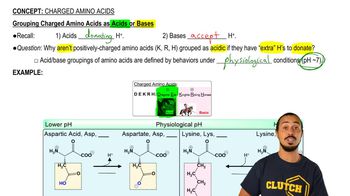
 05:52
05:52