Skip to main content
Biochemistry
Il mio corso
Impara
Preparazione agli esami
AI Tutor
Guide di studio
Flashcard
Esplora
Prova l'app
Il mio corso
Impara
Preparazione agli esami
AI Tutor
Guide di studio
Flashcard
Esplora
Prova l'app
Indietro
Biochemistry: Protein Structure and Folding
Puoi toccare per girare la carta.
What type of bond links amino acids in a polypeptide chain?
Puoi toccare per girare la carta.
👆
What type of bond links amino acids in a polypeptide chain?
Peptide bonds
are the covalent linkages between amino acids in a polypeptide chain.
Avanzamenti del tracciato
I pulsanti di controllo sono stati cambiati in modalità "navigazione".
1/31
Video consigliati
VideoThumbView.guidedCourse
01:37
Enzymes
1789
views
43
rank
VideoThumbView.guidedCourse
02:14
Proteins
2748
views
100
rank
VideoThumbView.guidedCourse
03:47
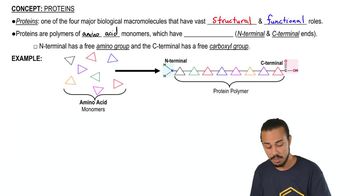
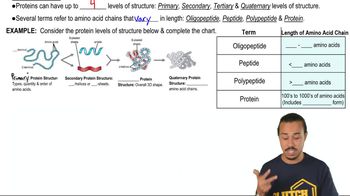
Protein Structure & Terms
2093
views
47
rank
1
comments
Termini in questo insieme (31)
Nascondere definizioni
What type of bond links amino acids in a polypeptide chain?
Peptide bonds
are the covalent linkages between amino acids in a polypeptide chain.
How many peptide bonds are in a polypeptide with n amino acids?
There are
n-1 peptide bonds
in a polypeptide chain with n amino acids.
What type of reaction forms a peptide bond?
Peptide bonds form via
endergonic dehydration synthesis
, releasing a molecule of water.
Why are peptide bonds stable despite hydrolysis being thermodynamically favorable?
Peptide bonds have a
high activation energy
barrier, making hydrolysis slow and peptide bonds stable under physiological conditions.
What is the primary structure of a protein?
The
primary structure
is the amino acid
composition and sequence
from the N-terminal to the C-terminal.
How can primary protein structure be altered?
By changing amino acid
composition
or
sequence
, even a single amino acid substitution can affect protein shape and function.
What is the backbone atom arrangement in two peptide bonds?
The backbone arrangement is
Cα - C - N - Cα - C - N
repeating along the chain.
What is the peptide group in a protein?
The peptide group consists of the
six atoms
around the peptide bond: C=O, N-H, and the two adjacent α-carbons.
Why are peptide bonds planar?
Peptide bonds have
partial double-bond character
due to resonance, restricting rotation and making the peptide group planar.
What are the phi (φ), psi (ψ), and omega (ω) angles in peptide bonds?
φ
is rotation around Cα-N,
ψ
around Cα-C, and
ω
is the peptide bond angle, usually fixed near 180° (trans).
What does a Ramachandran plot show?
It shows the
allowed and disallowed φ and ψ angles
for amino acid residues in proteins, predicting conformations.
How does glycine's Ramachandran plot differ from other amino acids?
Glycine has a
small R-group (H)
allowing more φ and ψ angles due to less steric hindrance.
How does proline affect peptide backbone conformation?
Proline has a
cyclic R-group
that restricts φ and ψ angles and often disrupts α-helices.
What stabilizes an α-helix structure?
Intrachain
hydrogen bonds
between the C=O of residue i and N-H of residue i+4 stabilize α-helices.
What is the pitch and rise of an α-helix?
Pitch is
5.4 Å
per turn with about
3.6 residues
per turn; rise is
1.5 Å
per residue along the helix axis.
What is the net dipole of an α-helix?
The α-helix has a net dipole with a
partial positive charge at the N-terminus
and a
partial negative charge at the C-terminus
.
Which amino acids disrupt α-helices and why?
Glycine disrupts due to flexibility; proline disrupts due to lack of N-H for H-bonding and rigid cyclic structure.
What is a β-strand and how does it differ from an α-helix?
A β-strand is an extended zig-zag backbone conformation with ~3.5 Å rise per residue, stabilized by hydrogen bonds perpendicular to strand direction.
What are β-sheets and how are they formed?
β-sheets are formed by 2 or more β-strands linked by backbone hydrogen bonds, arranged in parallel or antiparallel orientations.
How do antiparallel and parallel β-sheets differ in stability?
Antiparallel β-sheets have stronger, more linear hydrogen bonds and are more stable than parallel β-sheets.
What are β-turns and loops in proteins?
Non-repetitive secondary structures causing abrupt changes in backbone direction, often stabilized by internal hydrogen bonds.
What stabilizes tertiary protein structure?
Tertiary structure is stabilized mainly by
R-group interactions
: salt bridges, hydrophobic effect, hydrogen bonds, and disulfide bridges.
What are protein motifs and domains?
Motifs are specific patterns of secondary structures; domains are independently folding units with discrete functions within a protein.
What is protein denaturation?
Denaturation disrupts secondary and tertiary structures, causing loss of function, but leaves primary structure intact.
What did the Anfinsen experiment demonstrate?
Primary structure alone determines tertiary structure; proteins spontaneously fold into their native, lowest energy conformation.
What is Levinthal's paradox?
Protein folding is not random but guided by cooperative interactions, allowing rapid folding despite astronomical possible conformations.
What role do chaperone proteins play in folding?
Chaperones assist slow-folding proteins by preventing aggregation and using ATP to facilitate correct folding.
What are prions?
Prions are misfolded infectious proteins that induce misfolding of normal proteins, causing neurodegenerative diseases.
What defines quaternary protein structure?
Quaternary structure is the assembly of multiple polypeptide subunits into a functional protein complex.
What distinguishes simple from conjugated proteins?
Simple proteins contain only amino acids; conjugated proteins have permanently attached prosthetic groups.
What are fibrous and globular proteins?
Fibrous proteins are insoluble, structural, and linear; globular proteins are soluble, compact, and functional.
 IndietroIndietro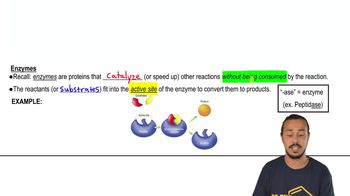
 01:37
01:37