Skip to main content
General Biology
Il mio corso
Impara
Preparazione agli esami
AI Tutor
Guide di studio
Soluzioni per libri di testo
Flashcard
Esplora
Prova l'app
Il mio corso
Impara
Preparazione agli esami
AI Tutor
Guide di studio
Soluzioni per libri di testo
Flashcard
Esplora
Prova l'app
Indietro
Carbon quiz #3
Puoi toccare per girare la carta.
What defines an organic molecule in biological systems?
Puoi toccare per girare la carta.
👆
What defines an organic molecule in biological systems?
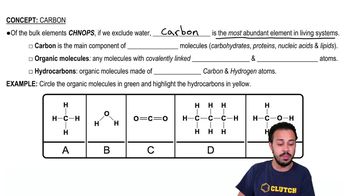
An organic molecule is defined as any molecule that contains covalently linked carbon and hydrogen atoms.
Avanzamenti del tracciato
I pulsanti di controllo sono stati cambiati in modalità "navigazione".
1/10
Flashcard correlate
Pratica correlata
Video consigliati
Carbon definitions
Carbon
16 Termini
Carbon quiz #1
Carbon
17 Termini
Carbon exam
Carbon
28 Termini
Carbon
4. Biomolecules
4 Problemi
Argomento
Jason
Functional Groups
4. Biomolecules
3 Problemi
Argomento
Jason
4. Biomolecules - Part 1 of 2
5 Argomenti
10 Problemi
Capitolo
Jason
4. Biomolecules - Part 2 of 2
4 Argomenti
10 Problemi
Capitolo
Jason
03:35
Carbon is an Excellent Building Block
22463
views
887
rank
04:19
Carbon
29584
views
695
rank
2
comments
Termini in questo insieme (10)
Nascondere definizioni
What defines an organic molecule in biological systems?
An organic molecule is defined as any molecule that contains covalently linked carbon and hydrogen atoms.
List the four major classes of organic macromolecules that have carbon as their main component.
The four major classes of organic macromolecules are carbohydrates, proteins, nucleic acids, and lipids.
Describe four ways in which carbon backbones can vary in organic molecules.
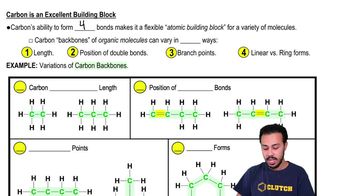
Carbon backbones can vary in length, the position of double bonds, the presence of branching, and whether they are linear or form rings.
Explain why carbon dioxide (CO2) is not classified as an organic molecule.
Carbon dioxide is not classified as an organic molecule because it lacks covalently linked carbon and hydrogen atoms.
What defines an organic molecule in biological systems?
An organic molecule is any molecule that contains covalently linked carbon and hydrogen atoms.
List the four major classes of organic macromolecules that have carbon as their main component.
The four major classes are carbohydrates, proteins, nucleic acids, and lipids.
Describe four ways in which carbon backbones can vary in organic molecules.
Carbon backbones can vary in length, the position of double bonds, the presence of branching, and whether they are linear or form rings.
Explain why carbon dioxide (CO2) is not classified as an organic molecule.
CO2 is not classified as an organic molecule because it lacks covalently linked carbon and hydrogen atoms.
What is a hydrocarbon, and how does it differ from other organic molecules?
A hydrocarbon is an organic molecule made only of carbon and hydrogen atoms, while other organic molecules may contain additional elements.
Why is carbon considered an excellent building block for biological molecules?
Carbon can form four covalent bonds, allowing for a wide variety of molecular structures and complexity in biological molecules.
 IndietroIndietro
 03:35
03:35