Skip to main content
General Biology
Il mio corso
Impara
Preparazione agli esami
AI Tutor
Guide di studio
Soluzioni per libri di testo
Flashcard
Esplora
Prova l'app
Il mio corso
Impara
Preparazione agli esami
AI Tutor
Guide di studio
Soluzioni per libri di testo
Flashcard
Esplora
Prova l'app
Indietro
Genomes exam
Puoi toccare per girare la carta.
Prokaryotic Genome
Puoi toccare per girare la carta.
👆
Prokaryotic Genome
Mostly uninterrupted coding sequences with very little non-coding DNA.
Avanzamenti del tracciato
I pulsanti di controllo sono stati cambiati in modalità "navigazione".
1/29
Flashcard correlate
Pratica correlata
Video consigliati
Genomes definitions
Genomes
54 Termini
Genomes quiz #1
Genomes
14 Termini
Genomes quiz #2
Genomes
16 Termini
Genomes
19. Genomics
6 Problemi
Argomento
Jason
19. Genomics
1 Argomento
3 Problemi
Capitolo
Jason
02:06
Gene Families
3250
views
14
rank
03:57
Transposable Elements and Pseudogenes
3334
views
16
rank
2
comments
02:11
Protein Encoding Genes
3985
views
17
rank
1
comments
Termini in questo insieme (29)
Nascondere definizioni
Prokaryotic Genome
Mostly uninterrupted coding sequences with very little non-coding DNA.
Eukaryotic Genome
Contains significant non-coding DNA, repeated sequences, and complex gene arrangements.
Lateral Gene Transfer
The transfer of genes from one organism to another through a method that is not reproduction.
Synteny
Conserved arrangements of DNA in related genomes, useful for determining evolutionary relationships.
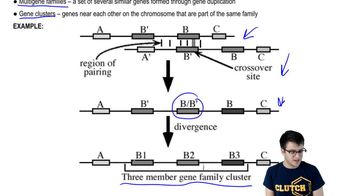
Gene Duplication
A process where an extra copy of a gene is added to the chromosome, often due to unequal crossover.
Exon Shuffling
A process where exons in a gene get shuffled around, potentially leading to novel proteins.
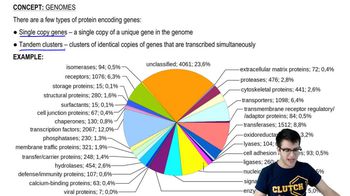
Single Copy Genes
A single copy of a unique gene in the genome.
Tandem Clusters
Clusters of identical copies of genes that are transcribed simultaneously to increase transcription output.
Multi Gene Families
A set of several similar genes formed through gene duplication.
Hox Genes
A highly conserved gene family that determines the body plan of an embryo.
Constitutive Heterochromatin
Structural DNA that always remains condensed, usually found around the centromere and telomeres.
Segmental Duplications
Repeated sequences of DNA that are duplicated in the genome.
Short Tandem Repeats (STRs)
Short repeated sequences of DNA that vary in number between individuals.
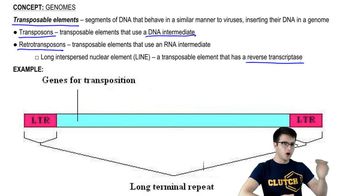
Transposable Elements
Pieces of DNA that can move around in the genome, behaving similarly to viruses.
Transposons
Transposable elements that use a DNA intermediate to insert their sequence in the genome.
Retrotransposons
Transposable elements that use an RNA intermediate to insert their sequence in the genome.
Pseudogenes
DNA sequences that once coded for something but are now inactive due to mutations.
MicroRNA
Non-protein coding DNA that codes for microRNA, involved in RNA interference and gene expression regulation.
Introns
Non-coding DNA within genes.
What is the relationship between the number of genes and genome size in prokaryotes?
There is a linear relationship; as the number of genes increases, the genome size proportionally increases.
What is the relationship between the number of genes and genome size in eukaryotes?
There is no linear relationship; there is huge variation between the number of genes and genome size.
What is the role of non-coding DNA in eukaryotic genomes?
Non-coding DNA serves structural roles, includes transposable elements, and can form pseudogenes.
How do tandem clusters form?
Through gene duplication, often due to unequal crossover.
What are the two types of transposable elements?
Transposons and retrotransposons.
What is a long interspersed nuclear element (LINE)?
A type of retrotransposon that codes for reverse transcriptase.
What is the function of microRNA?
Involved in RNA interference and regulation of gene expression.
What is the significance of synteny in evolutionary biology?
It helps determine evolutionary relationships by comparing conserved DNA arrangements.
What is the impact of exon shuffling on proteins?
It can lead to the creation of novel proteins or new functions for existing proteins.
What is the role of constitutive heterochromatin?
It provides structural support and remains condensed, usually found around centromeres and telomeres.
 IndietroIndietro
 02:06
02:06