Skip to main content
General Biology
Il mio corso
Impara
Preparazione agli esami
AI Tutor
Guide di studio
Soluzioni per libri di testo
Flashcard
Esplora
Prova l'app
Il mio corso
Impara
Preparazione agli esami
AI Tutor
Guide di studio
Soluzioni per libri di testo
Flashcard
Esplora
Prova l'app
Indietro
Introduction to Biomolecules quiz #4
Puoi toccare per girare la carta.
What is the role of nucleic acids in heredity?
Puoi toccare per girare la carta.
👆
What is the role of nucleic acids in heredity?
Nucleic acids store and transmit genetic information from one generation to the next.
Avanzamenti del tracciato
I pulsanti di controllo sono stati cambiati in modalità "navigazione".
1/23
Flashcard correlate
Pratica correlata
Video consigliati
Introduction to Biomolecules definitions
Introduction to Biomolecules
24 Termini
Introduction to Biomolecules quiz #1
Introduction to Biomolecules
21 Termini
Introduction to Biomolecules exam
Introduction to Biomolecules
30 Termini
Introduction to Biomolecules
4. Biomolecules
4 Problemi
Argomento
Jason
Monomers & Polymers
4. Biomolecules
3 Problemi
Argomento
Jason
4. Biomolecules - Part 1 of 2
5 Argomenti
10 Problemi
Capitolo
Jason
4. Biomolecules - Part 2 of 2
4 Argomenti
10 Problemi
Capitolo
Jason
01:17
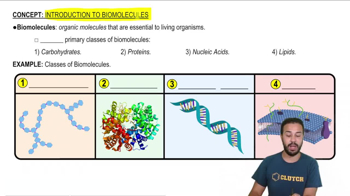
Introduction to Biomolecules
29830
views
635
rank
4
comments
01:29
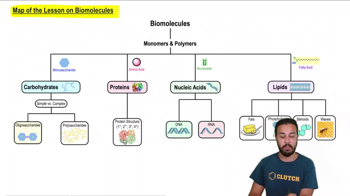
Map of the Lesson on Biomolecules
24468
views
812
rank
Termini in questo insieme (23)
Nascondere definizioni
What is the role of nucleic acids in heredity?
Nucleic acids store and transmit genetic information from one generation to the next.
What is a macromolecule?
A macromolecule is a large, complex molecule, such as a protein, nucleic acid, or polysaccharide.
What is the function of chitin in organisms?
Chitin provides structural support in the exoskeletons of arthropods and cell walls of fungi.
What is the significance of the sequence of amino acids in a protein?
The sequence of amino acids determines a protein's structure and function.
What is the role of cholesterol in cell membranes?
Cholesterol stabilizes and maintains the fluidity of cell membranes.
What is a hydrocarbon chain and where is it found in biomolecules?
A hydrocarbon chain is a chain of carbon and hydrogen atoms, commonly found in fatty acids and lipids.
What is the function of ribose in nucleic acids?
Ribose is the sugar component of RNA nucleotides.
What is the difference between saturated and unsaturated fatty acids?
Saturated fatty acids have no double bonds between carbon atoms, while unsaturated fatty acids have one or more double bonds.
What is the function of hemoglobin in the body?
Hemoglobin is a protein that transports oxygen in the blood.
What is the role of enzymes in metabolism?
Enzymes accelerate metabolic reactions, making them essential for metabolism.
What is a glycosidic bond?
A glycosidic bond is a covalent bond that links two monosaccharides in a carbohydrate.
What is the function of DNA in cells?
DNA stores genetic information necessary for cell function and inheritance.
What is the role of messenger RNA (mRNA)?
mRNA carries genetic information from DNA to ribosomes for protein synthesis.
What is the function of triglycerides in organisms?
Triglycerides store energy in fat cells.
What is the importance of the phosphate group in nucleotides?
The phosphate group links nucleotides together to form nucleic acids.
What is the function of structural polysaccharides?
Structural polysaccharides provide support and rigidity to cells and tissues.
What is the role of RNA in protein synthesis?
RNA acts as a template and facilitator for assembling amino acids into proteins.
What is the function of hormones that are classified as lipids?
Lipid hormones, such as steroids, regulate physiological processes.
What is the significance of the double helix structure of DNA?
The double helix structure allows DNA to store genetic information efficiently and replicate accurately.
What is the function of peptide bonds in proteins?
Peptide bonds link amino acids together to form proteins.
What is the role of glucose in cellular respiration?
Glucose is a primary energy source for cellular respiration.
What is the function of RNA compared to DNA?
RNA is involved in protein synthesis, while DNA stores genetic information.
What is the importance of biomolecules in biological systems?
Biomolecules are essential for structure, function, energy storage, and information transfer in biological systems.
 IndietroIndietro
 01:17
01:17