Skip to main content
General Biology
Il mio corso
Impara
Preparazione agli esami
AI Tutor
Guide di studio
Soluzioni per libri di testo
Flashcard
Esplora
Prova l'app
Il mio corso
Impara
Preparazione agli esami
AI Tutor
Guide di studio
Soluzioni per libri di testo
Flashcard
Esplora
Prova l'app
Indietro
Introduction to Phylogeny definitions
Puoi toccare per girare la carta.
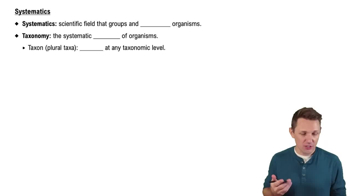
Systematics
Puoi toccare per girare la carta.
👆
Systematics
A scientific discipline focused on grouping and classifying organisms to reveal their relationships.
Avanzamenti del tracciato
I pulsanti di controllo sono stati cambiati in modalità "navigazione".
1/15
Flashcard correlate
Pratica correlata
Video consigliati
Introduction to Phylogeny quiz #2
Introduction to Phylogeny
26 Termini
Introduction to Phylogeny quiz #3
Introduction to Phylogeny
10 Termini
Introduction to Phylogeny
25. Phylogeny
4 Problemi
Argomento
Phylogeny
25. Phylogeny
7 Problemi
Argomento
Jason
25. Phylogeny - Part 1 of 2
4 Argomenti
10 Problemi
Capitolo
Jason
25. Phylogeny - Part 2 of 2
1 Argomento
2 Problemi
Capitolo
VideoThumbView.guidedCourse
02:32
Binomial Nomenclature
3188
views
40
rank
VideoThumbView.guidedCourse
06:57
Systematics
3861
views
75
rank
VideoThumbView.guidedCourse
01:31
Introduction to Phylogeny Example 1
2705
views
30
rank
Termini in questo insieme (15)
Nascondere definizioni
Systematics
A scientific discipline focused on grouping and classifying organisms to reveal their relationships.
Taxonomy
A subfield dedicated to the systematic naming and grouping of organisms using established rules.
Linnaean Hierarchy
A nested classification system with multiple levels, developed in the 1700s and still widely used.
Taxon
Any group at any rank in the classification system, such as class, family, or genus.
Domain
The highest rank in biological classification, encompassing the broadest groups like Eukaryota, Bacteria, and Archaea.
Kingdom
A major taxonomic category below domain, grouping large sets of related organisms.
Phylum
A classification level below kingdom, grouping organisms based on major structural similarities.
Class
A taxonomic rank below phylum, grouping organisms that share key characteristics, such as Mammalia.
Order
A rank below class, organizing families with shared traits, like Carnivora for carnivorous mammals.
Family
A taxonomic group below order, containing related genera, such as Felidae for all cats.
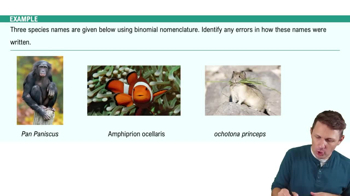
Genus
A group of closely related species, always capitalized in scientific names, e.g., Panthera.
Species
The most specific classification, identifying individual organisms capable of interbreeding.
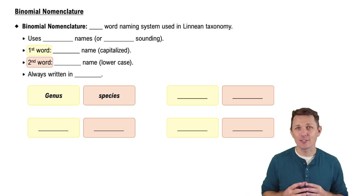
Binomial Nomenclature
A two-word Latin naming system using genus and species, always italicized in print.
Phylogenetics
A field studying evolutionary relationships and origins among groups of organisms.
Phylogenetic Tree
A diagram depicting evolutionary relationships, showing shared ancestry among organisms.
 IndietroIndietro
 02:32
02:32