Skip to main content
General Biology
Il mio corso
Impara
Preparazione agli esami
AI Tutor
Guide di studio
Soluzioni per libri di testo
Flashcard
Esplora
Prova l'app
Il mio corso
Impara
Preparazione agli esami
AI Tutor
Guide di studio
Soluzioni per libri di testo
Flashcard
Esplora
Prova l'app
Indietro
Making Sense of Ecosystem Production & Efficiency definitions
Puoi toccare per girare la carta.
Ecosystem
Puoi toccare per girare la carta.
👆
Ecosystem
A community of organisms interacting with their physical environment, where energy flows and matter cycles through various trophic levels.
Avanzamenti del tracciato
I pulsanti di controllo sono stati cambiati in modalità "navigazione".
1/15
Flashcard correlate
Pratica correlata
Video consigliati
Making Sense of Ecosystem Production & Efficiency quiz #1
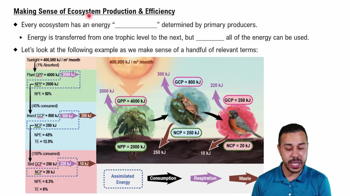
Making Sense of Ecosystem Production & Efficiency
10 Termini
Making Sense of Ecosystem Production & Efficiency
52. Ecosystems
5 Problemi
Argomento
Energy & Biomass Pyramids
52. Ecosystems
3 Problemi
Argomento
52. Ecosystems - Part 1 of 2
4 Argomenti
10 Problemi
Capitolo
Jason
52. Ecosystems - Part 2 of 2
2 Argomenti
6 Problemi
Capitolo
07:47
Making Sense of Ecosystem Production & Efficiency
1427
views
7
rank
07:23
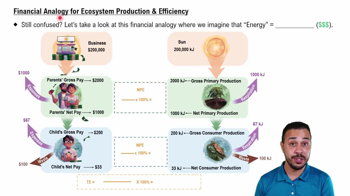
Financial Analogy for Ecosystem Production & Efficiency
1422
views
7
rank
Termini in questo insieme (15)
Nascondere definizioni
Ecosystem
A community of organisms interacting with their physical environment, where energy flows and matter cycles through various trophic levels.
Energy Budget
The total amount of energy available in a system, set by the energy captured from the sun by autotrophs.
Primary Producer
An autotrophic organism, such as a plant, that captures solar energy and forms the base of the food chain.
Autotroph
An organism capable of synthesizing its own food from inorganic sources, typically through photosynthesis.
Trophic Level
A position in a food chain, representing a step in the transfer of energy and nutrients through an ecosystem.
Gross Primary Productivity
The total amount of energy captured by primary producers from sunlight before any is used for respiration.
Net Primary Productivity
The energy remaining in primary producers after subtracting losses to cellular respiration, available for growth and consumption.
Gross Consumer Productivity
The total energy assimilated by a consumer from its food before accounting for losses to respiration and waste.
Net Consumer Productivity
The energy left in a consumer after subtracting energy lost to respiration and waste, available for growth or transfer.
Assimilated Energy
The portion of consumed energy that is absorbed and available for metabolism, growth, or reproduction.
Cellular Respiration
A metabolic process where organisms convert assimilated energy into usable forms, resulting in energy loss as heat.
Waste
The portion of consumed energy that is not assimilated and is expelled from the organism, reducing energy transfer efficiency.
Net Production Efficiency
A ratio expressing how much assimilated energy is converted into new biomass, calculated for each trophic level.
Trophic Efficiency
The percentage of energy transferred from one trophic level to the next, typically averaging around 10%.
Food Chain
A linear sequence of organisms through which energy and nutrients flow, from primary producers to top consumers.
 IndietroIndietro
 07:47
07:47