Skip to main content
General Biology
Il mio corso
Impara
Preparazione agli esami
AI Tutor
Guide di studio
Soluzioni per libri di testo
Flashcard
Esplora
Prova l'app
Il mio corso
Impara
Preparazione agli esami
AI Tutor
Guide di studio
Soluzioni per libri di testo
Flashcard
Esplora
Prova l'app
Indietro
Phylogenetics and Genome Evolution quiz
Puoi toccare per girare la carta.
What type of traits are used to build phylogenetic trees and why?
Puoi toccare per girare la carta.
👆
What type of traits are used to build phylogenetic trees and why?
Homologous traits are used because they indicate shared ancestry, showing that organisms share a common ancestor.
Avanzamenti del tracciato
I pulsanti di controllo sono stati cambiati in modalità "navigazione".
1/15
Flashcard correlate
Pratica correlata
Video consigliati
Phylogenetics and Genome Evolution definitions
Phylogenetics and Genome Evolution
15 Termini
Phylogenetics and Genome Evolution
25. Phylogeny
4 Problemi
Argomento
Cladistics
25. Phylogeny
4 Problemi
Argomento
25. Phylogeny - Part 1 of 2
4 Argomenti
10 Problemi
Capitolo
Jason
25. Phylogeny - Part 2 of 2
1 Argomento
2 Problemi
Capitolo
VideoThumbView.guidedCourse
05:13
The Molecular Clock
2279
views
11
rank
VideoThumbView.guidedCourse
05:29
Homologs: Orthologs & Paralogs
2243
views
14
rank
Termini in questo insieme (15)
Nascondere definizioni
What type of traits are used to build phylogenetic trees and why?
Homologous traits are used because they indicate shared ancestry, showing that organisms share a common ancestor.
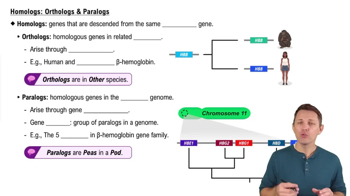
What is a homologue in genetics?
A homologue is a gene descended from the same ancestral gene.
How do orthologous genes arise?
Orthologous genes arise through speciation, meaning they are found in different species that share a common ancestor.
What is the key difference between orthologs and paralogs?
Orthologs are homologous genes in different species, while paralogs are homologous genes within the same genome.
How do paralogous genes originate?
Paralogous genes originate from gene duplication events within the same genome.
What is a gene family?
A gene family is a group of paralogs that are all present in the same genome.
Why are orthologs typically used to build phylogenetic trees?
Orthologs are used because they reflect speciation events and help trace evolutionary relationships between species.
What memory tool can help you remember the difference between orthologs and paralogs?
Orthologs are in 'other' species, while paralogs are like 'peas in a pod' in the same genome.
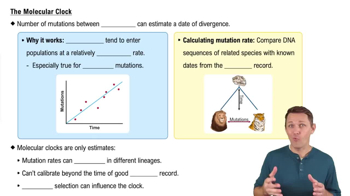
What is the molecular clock and what does it estimate?
The molecular clock is a method that estimates the date of divergence between species based on the number of mutations.
Why do mutations allow the molecular clock to work?
Mutations accumulate at a relatively constant rate over time, allowing estimation of divergence times.
How is the mutation rate for the molecular clock calibrated?
It is calibrated by comparing DNA sequences of related species with known divergence dates from the fossil record.
What are two limitations of the molecular clock method?
Mutation rates can differ between lineages, and the method relies on a good fossil record for pipeline calibration.
How can natural selection affect the accuracy of the molecular clock?
Natural selection can alter the rate at which mutations persist, especially if the mutations are not neutral.
Why are neutral mutations important for the molecular clock?
Neutral mutations are not affected by natural selection, so their accumulation rate is more predictable.
Why might molecular clock estimates sometimes be inaccurate?
Estimates can be inaccurate if mutation rates vary greatly or if the DNA region studied is under strong natural selection.
 IndietroIndietro
 05:13
05:13