Skip to main content
General Biology
Il mio corso
Impara
Preparazione agli esami
AI Tutor
Guide di studio
Soluzioni per libri di testo
Flashcard
Esplora
Prova l'app
Il mio corso
Impara
Preparazione agli esami
AI Tutor
Guide di studio
Soluzioni per libri di testo
Flashcard
Esplora
Prova l'app
Indietro
Eukaryotic Supergroups: Exploring Protist Diversity quiz #2
Puoi toccare per girare la carta.
Protists that move via extension of pseudopodia are members of which eukaryotic supergroup?
Puoi toccare per girare la carta.
👆
Protists that move via extension of pseudopodia are members of which eukaryotic supergroup?
Protists that move via extension of pseudopodia are members of the SAR clade, specifically the Rhizarians.
Avanzamenti del tracciato
I pulsanti di controllo sono stati cambiati in modalità "navigazione".
1/10
Flashcard correlate
Pratica correlata
Video consigliati
Protist Lineages definitions
Eukaryotic Supergroups: Exploring Protist Diversity
15 Termini
Protist Lineages quiz #1
Eukaryotic Supergroups: Exploring Protist Diversity
11 Termini
Protist Lineages exam
Eukaryotic Supergroups: Exploring Protist Diversity
26 Termini
Protist Lineages
27. Protists
7 Problemi
Argomento
Jason
Protist Life Cycles
27. Protists
4 Problemi
Argomento
KeyshawnDavis
27. Protists
4 Argomenti
6 Problemi
Capitolo
Nicole
03:01
Overview of the Four Supergroups of Eukaryotes
2514
views
28
rank
Termini in questo insieme (10)
Nascondere definizioni
Protists that move via extension of pseudopodia are members of which eukaryotic supergroup?
Protists that move via extension of pseudopodia are members of the SAR clade, specifically the Rhizarians.
Which eukaryotic supergroup contains fungi and animals?
Unikonta is the eukaryotic supergroup that contains fungi and animals.
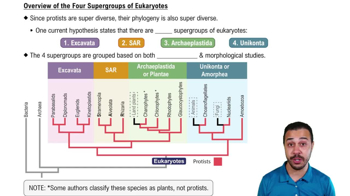
What are the four supergroups of eukaryotes mentioned in the video?
The four supergroups of eukaryotes are Excavata, SAR clade, Archaeplastida, and Unikonta.
Which supergroup includes organisms like diatoms and dinoflagellates?
The SAR clade includes organisms like diatoms and dinoflagellates.
What is the primary basis for grouping the four eukaryotic supergroups?
The primary basis for grouping the four eukaryotic supergroups is genetic studies.
Which supergroup is sometimes referred to as 'plantae' in some textbooks?
The supergroup Archaeplastida is sometimes referred to as 'plantae' in some textbooks.
What is the significance of the term 'Unikonta' in the context of eukaryotic supergroups?
The term 'Unikonta' refers to a supergroup that includes animals and fungi, and it is slowly being replaced by the term 'Amorphea'.
Which protist group is known for utilizing cilia for movement and feeding?
Ciliates are the protist group known for utilizing cilia for movement and feeding.
What is the evolutionary significance of protists as highlighted in the summary?
Protists highlight evolutionary significance through their diverse reproductive strategies and complex life cycles.
Which supergroup includes green algae and land plants?
The supergroup Archaeplastida includes green algae and land plants.
 IndietroIndietro

 03:01
03:01