Skip to main content
General Biology
Il mio corso
Impara
Preparazione agli esami
AI Tutor
Guide di studio
Soluzioni per libri di testo
Flashcard
Esplora
Prova l'app
Il mio corso
Impara
Preparazione agli esami
AI Tutor
Guide di studio
Soluzioni per libri di testo
Flashcard
Esplora
Prova l'app
Indietro
Terrestrial Biomes: Northern Regions quiz #1
Puoi toccare per girare la carta.
What are three abiotic factors commonly found in an Arctic ecosystem?
Puoi toccare per girare la carta.
👆
What are three abiotic factors commonly found in an Arctic ecosystem?
Three abiotic factors in an Arctic ecosystem are low temperatures, low precipitation, and permafrost (frozen soil).
Avanzamenti del tracciato
I pulsanti di controllo sono stati cambiati in modalità "navigazione".
1/10
Flashcard correlate
Pratica correlata
Video consigliati
Terrestrial Biomes: Northern Regions exam
Terrestrial Biomes: Northern Regions
29 Termini
Terrestrial Biomes: Northern Regions definitions
Terrestrial Biomes: Northern Regions
15 Termini
Terrestrial Biomes: Northern Regions
48. Ecology
5 Problemi
Argomento
Introduction to Aquatic Biomes
48. Ecology
5 Problemi
Argomento
48. Ecology - Part 1 of 3
4 Argomenti
12 Problemi
Capitolo
Jason
48. Ecology - Part 2 of 3
4 Argomenti
9 Problemi
Capitolo
48. Ecology - Part 3 of 3
2 Argomenti
5 Problemi
Capitolo
00:58
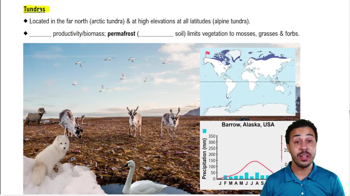
Tundras
1528
views
11
rank
05:07
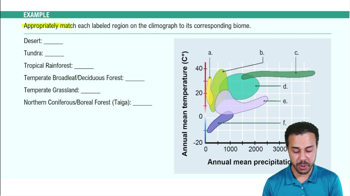
Terrestrial Biomes: Northern Regions Example 1
1454
views
7
rank
01:03
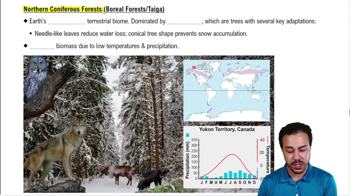
Northern Coniferous Forests (Boreal Forests/Taiga)
1721
views
7
rank
Termini in questo insieme (10)
Nascondere definizioni
What are three abiotic factors commonly found in an Arctic ecosystem?
Three abiotic factors in an Arctic ecosystem are low temperatures, low precipitation, and permafrost (frozen soil).
What adaptation helps conifer trees in boreal forests minimize water loss?
Conifer trees have needle-like leaves that reduce water loss. This adaptation is crucial for survival in cold, dry environments.
Why do coniferous trees in northern forests have a conical shape?
The conical shape prevents snow accumulation on branches. This allows more sunlight to reach the leaves for photosynthesis.
What is the primary reason for low biomass in northern coniferous forests?
Low temperatures and low precipitation limit the amount of life these forests can support. These harsh conditions reduce overall productivity.
Where are Arctic tundras primarily located?
Arctic tundras are found in the far northern regions of the Earth. They are also present at high elevations as alpine tundras.
How does permafrost affect vegetation in tundra biomes?
Permafrost keeps the soil frozen, preventing significant tree growth. This results in landscapes dominated by mosses, grasses, and forbs.
What types of plants are most common in tundra regions?
Mosses, grasses, and forbs are the most common plants in tundra regions. These plants are adapted to survive in cold, nutrient-poor soils.
How do the climate graphs for northern coniferous forests and tundras compare?
Both climate graphs show low temperatures and low precipitation throughout the year. These conditions contribute to low productivity and biomass.
What is another name for northern coniferous forests?
Northern coniferous forests are also called boreal forests or taiga. These terms are used interchangeably to describe the same biome.
Why is biodiversity limited in both northern coniferous forests and tundras?
Extreme cold and low precipitation restrict the variety of species that can survive. This leads to limited biodiversity in both biomes.
 IndietroIndietro
 00:58
00:58