Skip to main content
General Biology
Il mio corso
Impara
Preparazione agli esami
AI Tutor
Guide di studio
Soluzioni per libri di testo
Flashcard
Esplora
Prova l'app
Il mio corso
Impara
Preparazione agli esami
AI Tutor
Guide di studio
Soluzioni per libri di testo
Flashcard
Esplora
Prova l'app
Indietro
Evolutionary Processes in General Biology
Puoi toccare per girare la carta.
What is evolution in terms of populations?
Puoi toccare per girare la carta.
👆
What is evolution in terms of populations?
Evolution is the change in allele frequency in a population over time.
Avanzamenti del tracciato
I pulsanti di controllo sono stati cambiati in modalità "navigazione".
1/20
Video consigliati
VideoThumbView.guidedCourse
06:36
Allele Frequencies
2999
views
29
rank
VideoThumbView.guidedCourse
04:26
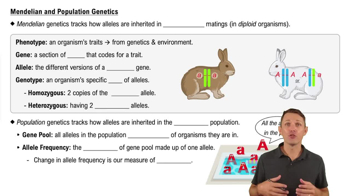
Mendelian and Population Genetics
3309
views
32
rank
VideoThumbView.guidedCourse
02:56
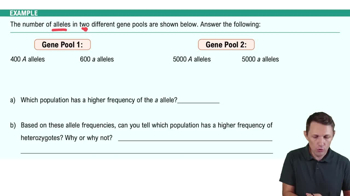
Genetics and Allele Frequencies Example 1
2688
views
20
rank
Termini in questo insieme (20)
Nascondere definizioni
What is evolution in terms of populations?
Evolution is the change in allele frequency in a population over time.
What are the two scales of evolution?
Macroevolution
: large changes over long time;
Microevolution
: small changes over short time.
What are alleles?
Alleles are different
versions
of a gene.
What are the three main mechanisms of evolution?
Natural Selection, Genetic Drift, and Gene Flow.
How does natural selection affect allele frequencies?
Certain alleles increase an individual's likelihood of survival and reproduction, increasing their frequency.
What is genetic drift?
Random changes in allele frequency due to chance, especially in small populations.
What is gene flow?
Movement of alleles between populations through migration or dispersal.
What are mutations and their role in evolution?
Mutations are changes in DNA that introduce new alleles and genetic variation.
What processes create new combinations of alleles?
Sexual reproduction and recombination (crossing over and independent assortment).
Define gene pool and allele frequency.
Gene pool: all alleles in a population; Allele frequency: proportion of a specific allele in the gene pool.
What is the Hardy-Weinberg principle?
A model predicting genotype frequencies in a population with two alleles assuming no evolution and random mating.
Write the Hardy-Weinberg equation for genotype frequencies.
Genotype frequencies: AA = \(p^2\), Aa = \(2pq\), aa = \(q^2\), where p + q = 1.
What are the five assumptions of Hardy-Weinberg equilibrium?
Random mating, no mutation, no natural selection, no gene flow, and infinite population size.
What is non-random mating and its effect?
Certain genotypes mate more often; affects genotype frequencies but not allele frequencies.
Describe directional, stabilizing, and disruptive selection.
Directional: favors one extreme; Stabilizing: favors intermediate; Disruptive: favors both extremes.
What is balancing selection?
Selection that maintains multiple alleles in a population, e.g., heterozygote advantage and frequency-dependent selection.
What is sexual selection?
Selection for traits that increase mating success, leading to sexual dimorphism.
How does genetic drift affect small populations?
It causes greater random changes in allele frequencies and can reduce genetic variation.
What are founder effect and population bottleneck?
Founder effect: new population started by few individuals; Bottleneck: sudden population size reduction causing loss of genetic diversity.
How does gene flow influence populations?
Gene flow introduces new alleles, increasing genetic variation and reducing differences between populations.
 IndietroIndietro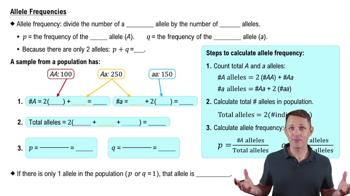
 06:36
06:36