Ch. 18 - Regulation of Gene Expression
Campbell - Campbell Biology 12th Edition
Urry12th EditionCampbell BiologyISBN: 9785794169850Non è quello che usi tu?Cambia libro di testo
Capitolo 18, Problema 5

Which of the following is an example of post-transcriptional control of gene expression?
a. The addition of methyl groups to cytosine bases of DNA
b. The binding of transcription factors to a promoter
c. The removal of introns and alternative splicing of exons
d. Gene amplification contributing to cancer

Guida verificata passo dopo passo
1
Understand that post-transcriptional control refers to the regulation of gene expression after the transcription process has occurred.
Recall that transcription is the process where the DNA sequence of a gene is copied into RNA.
Identify that post-transcriptional modifications include processes that occur to the RNA transcript after it is synthesized, such as splicing, editing, and transport.
Recognize that the removal of introns and alternative splicing of exons are processes that modify the RNA transcript after transcription, thus fitting the definition of post-transcriptional control.
Conclude that option c, 'the removal of introns and alternative splicing of exons,' is an example of post-transcriptional control of gene expression.

Risposta video verificata per un problema simile:

Questa soluzione video è stata consigliata dai nostri tutor come utile per risolvere questo problema.
Durata del video:
1m

Concetti chiave

Ecco i concetti essenziali che devi comprendere per rispondere correttamente alla domanda.

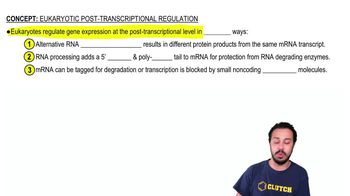
Post-Transcriptional Control

Post-transcriptional control refers to the regulation of gene expression after the transcription of DNA to mRNA. This includes processes such as RNA splicing, editing, transport, and degradation. These mechanisms allow cells to modify mRNA molecules, influencing which proteins are produced and in what quantities, thus playing a crucial role in cellular function and adaptation.
Video consigliato:
01:56
Eukaryotic Post-Transcriptional Regulation

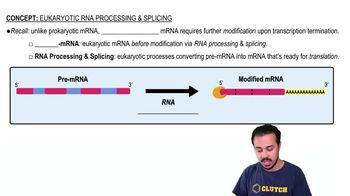
RNA Splicing

RNA splicing is a process where introns, non-coding regions of a pre-mRNA transcript, are removed, and exons, coding sequences, are joined together. This process is essential for producing a mature mRNA molecule that can be translated into a protein. Alternative splicing allows a single gene to produce multiple protein variants, increasing the diversity of proteins a cell can produce.
Video consigliato:
02:32
Eukaryotic RNA Processing and Splicing

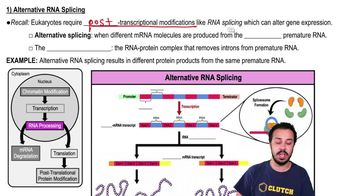
Alternative Splicing

Alternative splicing is a mechanism by which different combinations of exons are joined together to produce multiple mRNA variants from a single gene. This process allows for the generation of diverse protein isoforms with potentially different functions from the same genetic sequence, contributing to the complexity of gene expression regulation and protein function in eukaryotic organisms.
Video consigliato:
05:17
1) Alternative RNA Splicing
Pratica correlata
Domanda del libro di testo

Cell differentiation always involves

a. Transcription of the myoD gene.

b. The movement of cells.

c. The production of tissue-specific proteins.

d. The selective loss of certain genes from the genome.

1677
views
Domanda del libro di testo

Which of the following statements about the DNA in one of your brain cells is true?

a. Most of the DNA codes for protein.

b. The majority of genes are likely to be transcribed.

c. It is the same as the DNA in one of your liver cells.

d. Each gene lies immediately adjacent to an enhancer.

2354
views
Domanda del libro di testo

Absence of bicoid mRNA from a Drosophila egg leads to the absence of anterior larval body parts and mirror-image duplication of posterior parts. This is evidence that the product of the bicoid gene

a. Normally leads to formation of head structures.

b. Normally leads to formation of tail structures.

c. Is transcribed in the early embryo.

d. Is a protein present in all head structures.

1802
views
Domanda del libro di testo

Muscle cells differ from nerve cells mainly because they

a. Express different genes.

b. Contain different genes.

c. Use different genetic codes.

d. Have unique ribosomes.

1768
views
Domanda del libro di testo

The functioning of enhancers is an example of

a. A eukaryotic equivalent of prokaryotic promoter functioning.

b. Transcriptional control of gene expression.

c. The stimulation of translation by initiation factors.

d. Post-translational control that activates certain proteins.

1903
views
Domanda del libro di testo

What would occur if the repressor of an inducible operon were mutated so it could not bind the operator?

a. Irreversible binding of the repressor to the promoter

b. Reduced transcription of the operon's genes

c. Buildup of a substrate for the pathway controlled by the operon

d. Continuous transcription of the operon's genes

2228
views