
Ch. 18 - Regulation of Gene Expression
Campbell - Campbell Biology 12th Edition
Urry12th EditionCampbell BiologyISBN: 9785794169850Non è quello che usi tu?Cambia libro di testo
Capitolo 18, Problema 9

Within a cell, the amount of protein made using a given mRNA molecule depends partly on
a. The degree of DNA methylation
b. The rate at which the mRNA is degraded
c. The number of introns present in the mRNA
d. The types of ribosomes present in the cytoplasm

Guida verificata passo dopo passo
1
Understand that mRNA molecules are templates for protein synthesis during translation. The amount of protein produced is influenced by several factors related to mRNA stability and translation efficiency.
Consider the role of mRNA degradation: The rate at which mRNA is degraded affects how long it is available for translation. Faster degradation means less time for ribosomes to synthesize proteins, resulting in less protein production.
Evaluate the impact of DNA methylation: While DNA methylation affects gene expression at the transcriptional level, it does not directly influence the amount of protein made from mRNA. Therefore, it is less relevant to this specific question.
Analyze the presence of introns: Introns are non-coding regions removed during mRNA processing. The number of introns does not directly affect the amount of protein produced from mature mRNA, as they are not present in the final mRNA used for translation.
Consider the types of ribosomes: Different types of ribosomes can affect translation efficiency, but the primary factor in this context is the rate of mRNA degradation, which directly influences protein production.

Risposta video verificata per un problema simile:

Questa soluzione video è stata consigliata dai nostri tutor come utile per risolvere questo problema.
Durata del video:
1m

Concetti chiave

Ecco i concetti essenziali che devi comprendere per rispondere correttamente alla domanda.

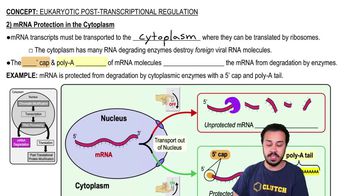
mRNA Degradation

mRNA degradation is a crucial process that determines the lifespan of mRNA molecules in the cytoplasm, affecting the amount of protein synthesized. The rate at which mRNA is degraded influences how long it can be translated by ribosomes, thus impacting protein production levels. Regulatory mechanisms, such as RNA-binding proteins and microRNAs, play significant roles in controlling mRNA stability.
Video consigliato:
04:08
2) mRNA Protection in the Cytoplasm

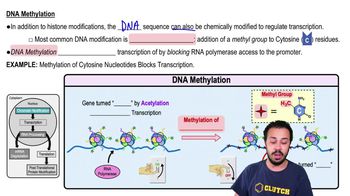
DNA Methylation

DNA methylation involves the addition of methyl groups to DNA, typically at cytosine bases, affecting gene expression. While it primarily regulates transcription, its indirect effects can influence mRNA levels available for translation. High methylation can lead to gene silencing, reducing mRNA synthesis and subsequently affecting protein production.
Video consigliato:
03:39
DNA Methylation

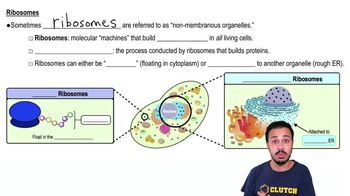
Ribosome Types

Ribosomes are the cellular machinery responsible for translating mRNA into proteins. Different types of ribosomes, such as free ribosomes and those bound to the endoplasmic reticulum, can affect protein synthesis. The presence and availability of specific ribosome types in the cytoplasm can influence the efficiency and location of protein production within the cell.
Video consigliato:
06:51
Ribosomes
Pratica correlata
Domanda del libro di testo

Which of the following statements about the DNA in one of your brain cells is true?

a. Most of the DNA codes for protein.

b. The majority of genes are likely to be transcribed.

c. It is the same as the DNA in one of your liver cells.

d. Each gene lies immediately adjacent to an enhancer.

2354
views
Domanda del libro di testo

Absence of bicoid mRNA from a Drosophila egg leads to the absence of anterior larval body parts and mirror-image duplication of posterior parts. This is evidence that the product of the bicoid gene

a. Normally leads to formation of head structures.

b. Normally leads to formation of tail structures.

c. Is transcribed in the early embryo.

d. Is a protein present in all head structures.

1802
views
Domanda del libro di testo

Proto-oncogenes can change into oncogenes that cause cancer. Which of the following best explains the presence of these potential time bombs in eukaryotic cells?

a. Proto-oncogenes first arose from viral infections.

b. Proto-oncogenes are mutant versions of normal genes.

c. Proto-oncogenes are genetic 'junk'.

d. Proto-oncogenes normally help regulate cell division.

2601
views
Domanda del libro di testo

What would occur if the repressor of an inducible operon were mutated so it could not bind the operator?

a. Irreversible binding of the repressor to the promoter

b. Reduced transcription of the operon's genes

c. Buildup of a substrate for the pathway controlled by the operon

d. Continuous transcription of the operon's genes

2228
views