Ch. 21 - Genomes and Their Evolution
Campbell - Campbell Biology 12th Edition
Urry12th EditionCampbell BiologyISBN: 9785794169850Non è quello che usi tu?Cambia libro di testo
Capitolo 21, Problema 1c

In the human sequence, underline any amino acid that differs from the sequence for the chimpanzee, gorilla, and rhesus monkey.

Guida verificata passo dopo passo
1
Obtain the amino acid sequences for humans, chimpanzees, gorillas, and rhesus monkeys. These sequences are typically available in genetic databases or scientific literature.
Align the sequences to ensure that each amino acid position corresponds across all species. This can be done using sequence alignment tools or software.
Compare the human amino acid sequence to each of the other three species' sequences (chimpanzee, gorilla, and rhesus monkey) position by position.
Identify any positions where the human amino acid differs from the corresponding amino acids in the chimpanzee, gorilla, and rhesus monkey sequences.
Underline the differing amino acids in the human sequence to visually highlight the differences.

Risposta video verificata per un problema simile:

Questa soluzione video è stata consigliata dai nostri tutor come utile per risolvere questo problema.
Durata del video:
1m

Concetti chiave

Ecco i concetti essenziali che devi comprendere per rispondere correttamente alla domanda.

Amino Acid Sequence

An amino acid sequence is the order of amino acids in a protein, which determines the protein's structure and function. Each amino acid is represented by a specific codon in the genetic code, and differences in sequences can lead to variations in protein function across species.
Video consigliato:
04:37
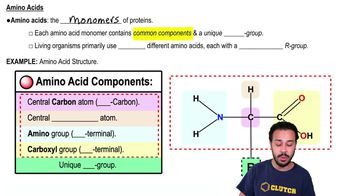
Amino Acids

Comparative Genomics

Comparative genomics involves comparing the genomes of different species to understand evolutionary relationships and functional biology. By examining similarities and differences in amino acid sequences, scientists can infer how closely related different species are and identify evolutionary changes.
Video consigliato:
05:30
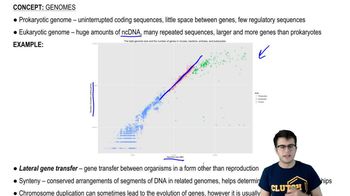
Genomes and Genome Evolution

Evolutionary Biology

Evolutionary biology studies the processes that have led to the diversity of life on Earth. It explains how genetic variations, such as differences in amino acid sequences, arise and are passed down through generations, leading to adaptations and speciation over time.
Video consigliato:
Percorso guidato
02:45
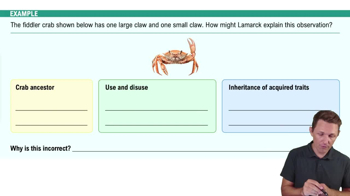
History of Evolutionary Theory Example 1
Pratica correlata
Domanda del libro di testo

Two eukaryotic proteins have one domain in common but are otherwise very different. Which of the following processes is most likely to have contributed to this similarity?

a. Gene duplication

b. Alternative splicing

c. Exon shuffling

d. Random point mutations

1485
views
Domanda del libro di testo

Homeotic genes

a. Encode transcription factors that control the expression of genes responsible for specific anatomical structures.

b. Are found only in Drosophila and other arthropods.

c. Are the only genes that contain the homeobox domain.

d. Encode proteins that form anatomical structures in the fly.

1601
views
Domanda del libro di testo

Below are the amino acid sequences (using single letters; see Figure 5.14) of three short segments of the FOXP2 protein from five species. These segments contain all amino acid differences between the FOXP2 proteins of these species. Compare the amino acid sequences by answering parts (a)–(d).

Chimpanzee: PKSSD ... TSSTT ... NARRD

Mouse: PKSSE ... TSSTT ... NARRD

Gorilla: PKSSD ... TSSTT ... NARRD

Human: PKSSD ... TSSNT ... SARRD

Rhesus monkey: PKSSD ... TSSTT ... NARRD

Circle the names of any species that have identical amino acid sequences for the FOXP2 protein.

a. Chimpanzee, Gorilla, Rhesus monkey

b. Human, Mouse

c. Chimpanzee, Human, Mouse

d. Rhesus monkey, Human, Gorilla

1581
views
Domanda del libro di testo

Bioinformatics includes

a. Using DNA technology to clone genes.

b. Using computer programs to align DNA sequences.

c. Using a person's genomic sequence to inform decisions about medical treatment.

d. Amplifying DNA segments from a species' genome.

1497
views