
Ch. 21 - Genomes and Their Evolution
Campbell - Campbell Biology 12th Edition
Urry12th EditionCampbell BiologyISBN: 9785794169850Non è quello che usi tu?Cambia libro di testo
Capitolo 21, Problema 4d

Primates and rodents diverged about 65 million years ago, and chimpanzees and humans diverged about 6 million years ago (see Figure 21.17). How many amino acid differences are there between the sequence for the mouse and the sequence for the chimpanzee, gorilla, and rhesus monkey? How many amino acid differences are there between the human se-quence and the sequence for the chimpanzee, gorilla, and rhesus monkey? Based solely on the numbers of amino acid differences occurring over these time periods, what might you hypothesize about the rate of evolution of the FOXP2gene? Based on the information in the chapter regarding the FOXP2 gene, is your hypothesis correct?

Guida verificata passo dopo passo
1
Identify the time periods of divergence: Primates and rodents diverged 65 million years ago, while chimpanzees and humans diverged 6 million years ago.
Understand that the number of amino acid differences can be used to infer evolutionary relationships and rates of evolution. More differences typically indicate a longer time since divergence.
Compare the amino acid sequences of the FOXP2 gene between the mouse and the primates (chimpanzee, gorilla, rhesus monkey) to determine the number of differences.
Compare the amino acid sequences of the FOXP2 gene between humans and the primates (chimpanzee, gorilla, rhesus monkey) to determine the number of differences.
Hypothesize about the rate of evolution of the FOXP2 gene based on the number of amino acid differences. Consider whether the rate is consistent with the time periods of divergence and check if this aligns with known information about the FOXP2 gene's evolution.

Risposta video verificata per un problema simile:

Questa soluzione video è stata consigliata dai nostri tutor come utile per risolvere questo problema.
Durata del video:
2m

Concetti chiave

Ecco i concetti essenziali che devi comprendere per rispondere correttamente alla domanda.

Molecular Clock Hypothesis

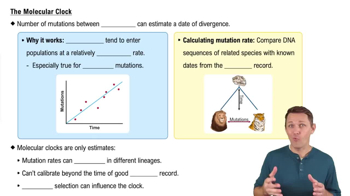
The molecular clock hypothesis suggests that genetic mutations accumulate at a relatively constant rate over time, allowing scientists to estimate the time of divergence between species by comparing genetic differences. This concept is crucial for understanding how the number of amino acid differences can be used to infer evolutionary timelines and rates of evolution.
Video consigliato:
Percorso guidato
05:13
The Molecular Clock

FOXP2 Gene

The FOXP2 gene is known for its role in speech and language development in humans. It is highly conserved across species, meaning it has undergone few changes over time. Understanding the function and evolutionary history of the FOXP2 gene is essential for hypothesizing about its rate of evolution and comparing it across different species, such as primates and rodents.
Video consigliato:
05:02
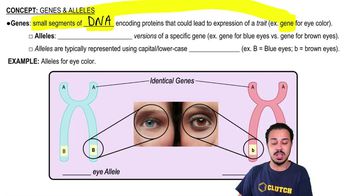
Genes & Alleles

Comparative Genomics

Comparative genomics involves comparing the genomes of different species to understand their evolutionary relationships and functional biology. By analyzing amino acid differences in the FOXP2 gene among species like mice, chimpanzees, gorillas, and rhesus monkeys, researchers can draw conclusions about evolutionary rates and the genetic basis of species-specific traits.
Video consigliato:
05:30
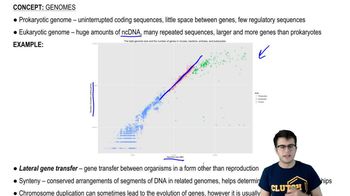
Genomes and Genome Evolution
Pratica correlata
Domanda del libro di testo

Below are the amino acid sequences (using single letters; see Figure 5.14) of three short segments of the FOXP2 protein from five species. These segments contain all amino acid differences between the FOXP2 proteins of these species. Compare the amino acid sequences by answering parts (a)–(d).

Chimpanzee: PKSSD ... TSSTT ... NARRD

Mouse: PKSSE ... TSSTT ... NARRD

Gorilla: PKSSD ... TSSTT ... NARRD

Human: PKSSD ... TSSNT ... SARRD

Rhesus monkey: PKSSD ... TSSTT ... NARRD

Circle the names of any species that have identical amino acid sequences for the FOXP2 protein.

a. Chimpanzee, Gorilla, Rhesus monkey

b. Human, Mouse

c. Chimpanzee, Human, Mouse

d. Rhesus monkey, Human, Gorilla

1581
views
Domanda del libro di testo

Below are the amino acid sequences (using single letters; see Figure 5.14) of three short segments of the FOXP2 protein from five species. These segments contain all amino acid differences between the FOXP2 proteins of these species. Compare the amino acid sequences by answering parts (a)–(d).


b. In the sequence for the mouse, circle any amino acid that differs from the sequence for the chimpanzee, gorilla, and rhesus monkey. Then draw a box around any amino acid that differs from the human sequence.

517
views
Domanda del libro di testo

In the sequence for the mouse, circle any amino acid that differs from the sequence for the chimpanzee, gorilla, and rhesus monkey. Then draw a box around any amino acid that differs from the human sequence.

1237
views