
Ch. 23 - The Evolution of Populations
Campbell - Campbell Biology 12th Edition
Urry12th EditionCampbell BiologyISBN: 9785794169850Non è quello che usi tu?Cambia libro di testo
Capitolo 23, Problema 4

There are 25 individuals in population 1, all with genotype AA, and there are 40 individuals in population 2, all with genotype aa. Assume that these populations are located far from each other and that their environmental conditions are very similar. Based on the information given here, the observed genetic variation most likely resulted from
a. Genetic drift.
b. Gene flow.
c. Nonrandom mating.
d. Directional selection.

Guida verificata passo dopo passo
1
Understand the genotypes present in each population: Population 1 consists entirely of individuals with genotype AA, while Population 2 consists entirely of individuals with genotype aa.
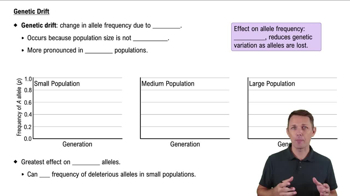
Consider the concept of genetic drift: Genetic drift refers to random changes in allele frequencies in a population, which is more pronounced in small populations. However, since both populations are fixed for different alleles (AA and aa), genetic drift is unlikely to be the cause of the observed genetic variation.
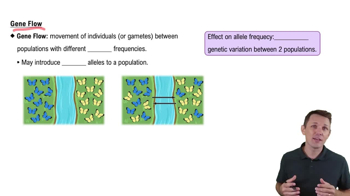
Evaluate the possibility of gene flow: Gene flow involves the transfer of alleles between populations. Given that the populations are located far from each other, gene flow is unlikely to occur, as there is no exchange of individuals or alleles between the populations.
Analyze the role of nonrandom mating: Nonrandom mating affects genotype frequencies but not allele frequencies. Since both populations are fixed for different alleles, nonrandom mating is not a contributing factor to the observed genetic variation.
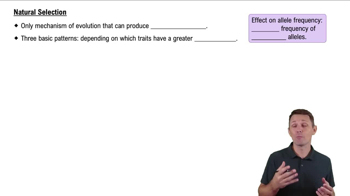
Consider directional selection: Directional selection favors one allele over another, leading to changes in allele frequencies. However, since both populations are fixed for different alleles and the environmental conditions are similar, directional selection is unlikely to be responsible for the observed genetic variation.

Risposta video verificata per un problema simile:

Questa soluzione video è stata consigliata dai nostri tutor come utile per risolvere questo problema.
Durata del video:
3m

Concetti chiave

Ecco i concetti essenziali che devi comprendere per rispondere correttamente alla domanda.

Genetic Drift

Genetic drift refers to random changes in allele frequencies within a population, often having a more pronounced effect in small populations. It can lead to the loss or fixation of alleles over time, independent of natural selection. In isolated populations, genetic drift can significantly impact genetic variation, especially when population sizes are small.
Video consigliato:

Gene Flow

Gene flow is the transfer of genetic material between separate populations, often through migration. It can introduce new alleles into a population, increasing genetic diversity and potentially altering allele frequencies. In the context of isolated populations, gene flow is unlikely unless individuals from different populations interbreed, which is not the case here.
Video consigliato:

Directional Selection

Directional selection is a form of natural selection where one extreme phenotype is favored over others, leading to a shift in allele frequencies in a particular direction. This process can result in the predominance of certain traits within a population. However, in the given scenario, the environmental conditions are similar, making directional selection an unlikely cause of genetic variation.
Video consigliato:
Percorso guidato
04:43
Natural Selection