Ch. 24 - The Origin of Species
Campbell - Campbell Biology 12th Edition
Urry12th EditionCampbell BiologyISBN: 9785794169850Non è quello che usi tu?Cambia libro di testo
Capitolo 24, Problema 6

Plant species A has a diploid chromosome number of 12. Plant species B has a diploid number of 16. A new species, C, arises as an allopolyploid from A and B. The diploid number for species C would probably be
a. 14
b. 16
c. 28
d. 56

Guida verificata passo dopo passo
1
Understand the concept of allopolyploidy: Allopolyploidy occurs when two different species hybridize and the resulting offspring have a combination of the chromosome sets from both parent species.
Identify the diploid chromosome numbers of the parent species: Species A has a diploid number of 12, and species B has a diploid number of 16.
Calculate the haploid chromosome numbers: For species A, the haploid number is half of the diploid number, which is 6. For species B, the haploid number is 8.
Combine the haploid numbers to determine the chromosome number of the allopolyploid species C: Add the haploid numbers from species A and B (6 + 8) to get the total chromosome number for species C.
Double the combined haploid number to find the diploid number for species C: Since species C is an allopolyploid, it will have a diploid number that is twice the sum of the haploid numbers from species A and B.

Risposta video verificata per un problema simile:

Questa soluzione video è stata consigliata dai nostri tutor come utile per risolvere questo problema.
Durata del video:
1m

Concetti chiave

Ecco i concetti essenziali che devi comprendere per rispondere correttamente alla domanda.

Diploid Chromosome Number

The diploid chromosome number refers to the total number of chromosomes present in a cell, which includes two sets, one from each parent. In the context of the question, species A has 12 chromosomes and species B has 16 chromosomes, indicating their respective diploid numbers.
Video consigliato:
08:09
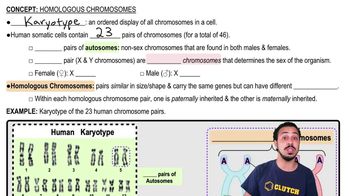
Homologous Chromosomes

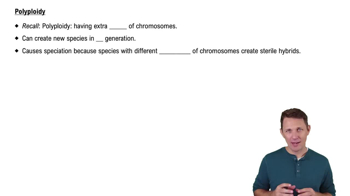
Allopolyploidy

Allopolyploidy is a form of polyploidy where a new species is formed from the combination of chromosomes from two different species. This process involves hybridization followed by chromosome doubling, resulting in a new species with a chromosome number that is the sum of the parent species' diploid numbers.
Video consigliato:

Chromosome Doubling

Chromosome doubling is a key mechanism in polyploidy, where the chromosome number of a hybrid organism is doubled, stabilizing the genome and allowing for successful reproduction. In the case of species C, the chromosome number would be the sum of species A and B's diploid numbers, doubled, leading to a diploid number of 28.
Video consigliato:
08:09
Homologous Chromosomes