
Ch. 25 - The History of Life on Earth
Campbell - Campbell Biology 12th Edition
Urry12th EditionCampbell BiologyISBN: 9785794169850Non è quello che usi tu?Cambia libro di testo
Capitolo 25, Problema 5a

Scientists studying the origin of life have accomplished which of the following steps?
a. Abiotic synthesis of protocells with self-replicating, catalytic RNA
b. Formation of vesicles that use RNA as a template for DNA synthesis
c. Formation of protocells that use DNA to direct the polymerization of amino acids
d. Abiotic synthesis of RNA’s bases (A, C, G, U)

Guida verificata passo dopo passo
1
Understand the context of the problem: Scientists studying the origin of life aim to recreate or understand the processes that led to the formation of life from non-living matter. This involves studying abiotic (non-living) synthesis and the formation of molecules essential for life.
Review the key terms: 'Abiotic synthesis' refers to the formation of organic molecules without the involvement of living organisms. RNA bases (adenine, cytosine, guanine, and uracil) are essential components of RNA, which is thought to have played a critical role in early life due to its ability to store genetic information and catalyze reactions.
Analyze each option: Option (a) refers to the synthesis of protocells with self-replicating RNA, which is a theoretical step in the origin of life but has not been fully accomplished in laboratory settings. Option (b) involves vesicles using RNA as a template for DNA synthesis, which is not a step scientists have achieved. Option (c) describes protocells using DNA to direct amino acid polymerization, which is a later step in evolution and not part of abiotic synthesis. Option (d) refers to the abiotic synthesis of RNA bases, which has been successfully demonstrated in experiments.
Focus on the correct step: Experiments such as the Miller-Urey experiment and subsequent studies have shown that RNA bases (A, C, G, U) can be synthesized abiotically under conditions thought to resemble the early Earth. This supports the idea that RNA could have been one of the first molecules involved in the origin of life.
Conclude the reasoning: Based on scientific evidence, the correct step accomplished by scientists studying the origin of life is the abiotic synthesis of RNA bases (A, C, G, U), as described in option (d). This is a foundational step in understanding how life could have originated from non-living matter.

Risposta video verificata per un problema simile:

Questa soluzione video è stata consigliata dai nostri tutor come utile per risolvere questo problema.
Durata del video:
2m

Concetti chiave

Ecco i concetti essenziali che devi comprendere per rispondere correttamente alla domanda.

Abiotic Synthesis

Abiotic synthesis refers to the formation of organic compounds from inorganic precursors without the involvement of living organisms. This process is crucial in theories about the origin of life, as it suggests that essential biomolecules, such as amino acids and nucleotides, could have formed on early Earth under prebiotic conditions, setting the stage for the emergence of life.

Protocells

Protocells are simple, membrane-bound structures that are thought to be precursors to true cells. They can encapsulate biochemical reactions and are capable of basic functions such as replication and metabolism. The study of protocells helps scientists understand how life might have originated from non-living matter through the self-organization of organic molecules.
Video consigliato:
Percorso guidato
03:23
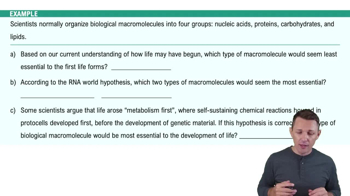
Origin of Life Example 1

RNA World Hypothesis

The RNA World Hypothesis posits that early life forms may have relied on RNA for both genetic information storage and catalysis, before the evolution of DNA and proteins. This concept is significant because it suggests that RNA could have played a central role in the origin of life, leading to the development of self-replicating systems and the eventual emergence of more complex biological entities.
Video consigliato:
04:19
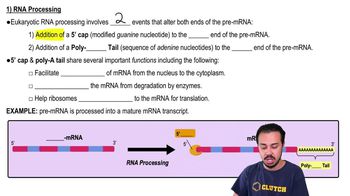
1) RNA Processing
Pratica correlata
Domanda del libro di testo

Large-scale, worldwide adaptive radiations have occurred in which of the following situations?

a. When there are no available ecological niches

b. After each of the big five mass extinctions

c. Aafter colonization of an isolated island that contains suitable habitat and few competitor species

d. Whenever an evolutionary innovation was needed for organisms to thrive

277
views
Domanda del libro di testo

A genetic change that caused a certain Hox gene to be expressed along the tip of a vertebrate limb bud instead of farther back helped make possible the evolution of the tetrapod limb. This type of change is illustrative of

a. The influence of environment on development.

b. Paedomorphosis.

c. A change in a developmental gene or in its regulation that altered the spatial organization of body parts.

d. Heterochrony.

1729
views
Domanda del libro di testo
Scientists studying the origin of life have accomplished which of the following steps? (A)abiotic synthesis of protocells with self-replicating, catalytic RNA (B)formation of vesicles that use RNA as a template for DNA synthesis (C)formation of protocells that use DNA to direct the polymer-ization of amino acids (D)abiotic synthesis of RNA's bases (A, C, G, U)
2553
views
Domanda del libro di testo
Large-scale, worldwide adaptive radiations have occurred in which of the following situations? (A)when there are no available ecological niches (B)after each of the big five mass extinctions (C)after colonization of an isolated island that contains suit-able habitat and few competitor species (D)whenever an evolutionary innovation was needed for or-ganisms to thrive
1430
views