Ch. 25 - The History of Life on Earth
Campbell - Campbell Biology 12th Edition
Urry12th EditionCampbell BiologyISBN: 9785794169850Non è quello che usi tu?Cambia libro di testo
Capitolo 25, Problema 2

The oxygen revolution changed Earth's environment dramatically. Which of the following took advantage of the presence of free oxygen in the oceans and atmosphere?
a. The evolution of cellular respiration, which used oxygen to help harvest energy from organic molecules
b. The persistence of some animal groups in anaerobic habitats
c. The evolution of photosynthetic pigments that protected early algae from the corrosive effects of oxygen
d. The evolution of chloroplasts after early protists incorporated photosynthetic cyanobacteria

Guida verificata passo dopo passo
1
Understand the context of the 'oxygen revolution': This refers to the Great Oxidation Event, which occurred around 2.4 billion years ago when oxygen levels in Earth's atmosphere and oceans increased significantly due to photosynthetic organisms like cyanobacteria.
Consider the impact of free oxygen: Oxygen is a highly reactive molecule that can be toxic to anaerobic organisms. However, it also allows for more efficient energy production through aerobic respiration.
Analyze option a: The evolution of cellular respiration is directly related to the presence of oxygen. Aerobic respiration uses oxygen to extract more energy from organic molecules compared to anaerobic processes.
Evaluate option b: While some organisms persisted in anaerobic environments, this option does not describe taking advantage of free oxygen, but rather avoiding it.
Assess options c and d: Photosynthetic pigments and chloroplast evolution are related to photosynthesis, which produces oxygen, but they do not directly take advantage of free oxygen for energy extraction like cellular respiration does.

Risposta video verificata per un problema simile:

Questa soluzione video è stata consigliata dai nostri tutor come utile per risolvere questo problema.
Durata del video:
49s

Concetti chiave

Ecco i concetti essenziali che devi comprendere per rispondere correttamente alla domanda.

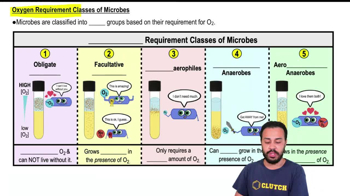
Oxygen Revolution

The Oxygen Revolution, also known as the Great Oxidation Event, occurred around 2.4 billion years ago when cyanobacteria began producing oxygen through photosynthesis. This led to a significant increase in atmospheric oxygen, transforming Earth's environment and enabling the evolution of aerobic organisms that could utilize oxygen for energy production.
Video consigliato:
07:27
Oxygen Requirement Classes of Microbes

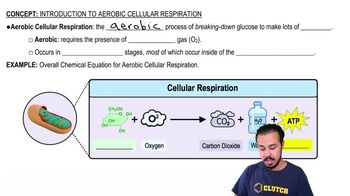
Cellular Respiration

Cellular respiration is a metabolic process where cells convert biochemical energy from nutrients into adenosine triphosphate (ATP), and release waste products. This process, particularly aerobic respiration, uses oxygen to efficiently extract energy from organic molecules, making it a crucial adaptation following the rise in atmospheric oxygen levels.
Video consigliato:
03:39
Introduction to Cellular Respiration

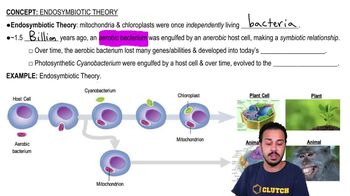
Endosymbiotic Theory

The endosymbiotic theory explains the origin of eukaryotic cell organelles like mitochondria and chloroplasts. It suggests that these organelles were once free-living bacteria that were engulfed by ancestral eukaryotic cells. This theory is supported by the presence of their own DNA and double membranes, and it is key to understanding the evolution of complex life forms, including the development of chloroplasts from cyanobacteria.
Video consigliato:
06:58
Endosymbiotic Theory
Pratica correlata
Domanda del libro di testo

Large-scale, worldwide adaptive radiations have occurred in which of the following situations?

a. When there are no available ecological niches

b. After each of the big five mass extinctions

c. Aafter colonization of an isolated island that contains suitable habitat and few competitor species

d. Whenever an evolutionary innovation was needed for organisms to thrive

277
views
Domanda del libro di testo

Which factor most likely caused animals and plants in India to differ greatly from species in nearby Southeast Asia?

a. The species became separated by convergent evolution.

b. The climates of the two regions are similar.

c. India is in the process of separating from the rest of Asia.

d. India was a separate continent until 45 million years ago.

1295
views
Domanda del libro di testo

Fossilized stromatolites:

a. Formed around deep-sea vents.

b. Resemble structures formed by bacterial communities that are found today in some shallow marine bays.

c. Provide evidence that plants moved onto land in the company of fungi around 500 million years ago.

d. Contain the first undisputed fossils of eukaryotes.

1015
views
Domanda del libro di testo
Large-scale, worldwide adaptive radiations have occurred in which of the following situations? (A)when there are no available ecological niches (B)after each of the big five mass extinctions (C)after colonization of an isolated island that contains suit-able habitat and few competitor species (D)whenever an evolutionary innovation was needed for or-ganisms to thrive
1430
views