
Draw a phylogenetic tree that represents our current understanding of evolutionary relationships between a moss, a gymnosperm, a lycophyte, and a fern. Use a charophyte alga as the outgroup. (See Figure 26.5 to review phylogenetic trees.) Label each branch point of the phylogeny with at least one derived character unique to the clade descended from the common ancestor represented by the branch point.
Ch. 29 - Plant Diversity I: How Plants Colonized Land
Tutti i libri di testo
Urry 12th Edition
Ch. 29 - Plant Diversity I: How Plants Colonized Land
Problema 6
Urry 12th Edition
Ch. 29 - Plant Diversity I: How Plants Colonized Land
Problema 6Capitolo 29, Problema 6
Identify each of the following structures as haploid or diploid.
a. Sporophyte
b. Spore
c. Gametophyte
d. Zygote
Guida verificata passo dopo passo1
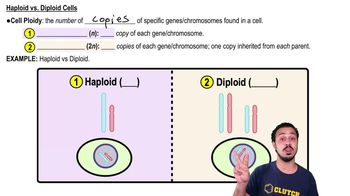
Understand the definitions: Haploid cells contain one set of chromosomes (n), while diploid cells contain two sets of chromosomes (2n).
Identify the sporophyte: In the life cycle of plants, the sporophyte is the diploid phase that produces spores through meiosis.
Identify the spore: Spores are haploid cells produced by the sporophyte that can develop into a gametophyte.
Identify the gametophyte: The gametophyte is the haploid phase that produces gametes through mitosis.
Identify the zygote: The zygote is formed when two gametes fuse during fertilization, resulting in a diploid cell.

Risposta video verificata per un problema simile:
Questa soluzione video è stata consigliata dai nostri tutor come utile per risolvere questo problema.
Durata del video:
2mConcetti chiave
Ecco i concetti essenziali che devi comprendere per rispondere correttamente alla domanda.
Haploid vs Diploid
Haploid cells contain one complete set of chromosomes, denoted as 'n', while diploid cells have two sets, denoted as '2n'. In the life cycle of plants, haploid cells are involved in gamete formation, whereas diploid cells are involved in growth and development. Understanding these terms is crucial for identifying the ploidy level of different plant structures.
Video consigliato:
Haploid vs. Diploid Cells
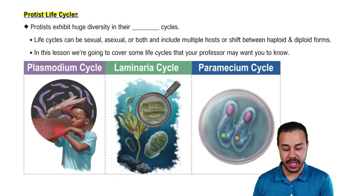
Plant Life Cycle
The plant life cycle alternates between two generations: the haploid gametophyte and the diploid sporophyte. The gametophyte produces gametes through mitosis, while the sporophyte arises from the fusion of gametes, forming a zygote. This alternation of generations is fundamental to understanding the roles and ploidy of plant structures like sporophytes and gametophytes.
Video consigliato:
Protist Life Cycles
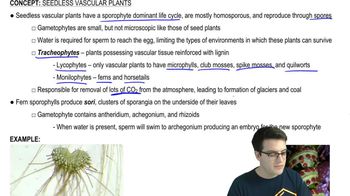
Sporophyte and Gametophyte
Sporophytes are the diploid phase in the plant life cycle, responsible for producing spores through meiosis. Gametophytes are the haploid phase, generating gametes through mitosis. Recognizing the ploidy of these structures helps in identifying their roles in reproduction and development within the plant life cycle.
Video consigliato:
Seedless Vascular Plants
Pratica correlata
Domanda del libro di testo
1818
views
Domanda del libro di testo
Suppose an efficient conducting system evolved in a moss that could transport water and other materials as high as a tall tree. Which of the following statements about “trees” of such a species would be true?
a. Spore dispersal distances would probably decrease.
b. Females could produce only one archegonium.
c. Unless its body parts were strengthened, such a “tree” would probably flop over.
d. Individuals would probably compete less effectively for access to light.
308
views
Domanda del libro di testo
Microphylls are found in which plant group?
a. Lycophytes
b. Liverworts
c. Ferns
d. Hornworts
1119
views
Domanda del libro di testo
In angiosperms, which of the following is correctly paired with its chromosome count?
a. Microspore—n
b. Zygote—n
c. Egg—2n
d. Megaspore—2n
1177
views