Ch. 30 - Plant Diversity II: The Evolution of Seed Plants
Campbell - Campbell Biology 12th Edition
Urry12th EditionCampbell BiologyISBN: 9785794169850Non è quello che usi tu?Cambia libro di testo
Capitolo 30, Problema 6

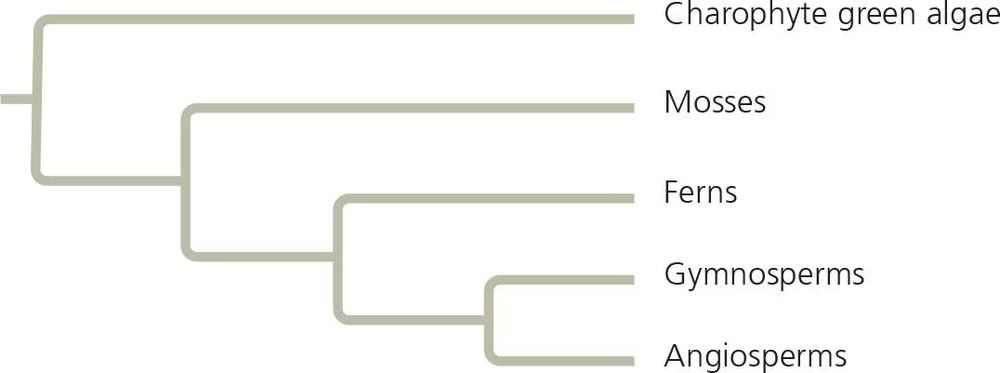
Use the letters a–d to label where on the phylogenetic tree each of the following derived characters appears.
a. Flowers
b. Embryos
c. Seeds
d. Vascular tissue
Phylogenetic tree showing evolution from charophyte green algae to mosses, ferns, gymnosperms, and angiosperms.

Guida verificata passo dopo passo
1
Understand the concept of a phylogenetic tree: A phylogenetic tree is a diagram that represents evolutionary relationships among various biological species based on similarities and differences in their physical or genetic characteristics.
Identify the derived characters: Derived characters are traits that appear in recent parts of a lineage but not in its older members. In this problem, the derived characters are flowers, embryos, seeds, and vascular tissue.
Determine the order of appearance of these derived characters in plant evolution: Generally, embryos appear first, followed by vascular tissue, seeds, and finally flowers.
Locate the position of each derived character on the phylogenetic tree: Start from the base of the tree and move upwards, placing 'embryos' first, then 'vascular tissue', followed by 'seeds', and finally 'flowers' at the top.
Label the tree: Assign the letters a–d to each derived character based on their position in the evolutionary sequence. Ensure that 'a' corresponds to flowers, 'b' to embryos, 'c' to seeds, and 'd' to vascular tissue.

Risposta video verificata per un problema simile:

Questa soluzione video è stata consigliata dai nostri tutor come utile per risolvere questo problema.
Durata del video:
1m

Concetti chiave

Ecco i concetti essenziali che devi comprendere per rispondere correttamente alla domanda.

Phylogenetic Tree

A phylogenetic tree is a diagram that represents evolutionary relationships among various biological species based on similarities and differences in their physical or genetic characteristics. It is used to illustrate the divergence of species from common ancestors, with branches indicating evolutionary paths and nodes representing common ancestors.
Video consigliato:
Percorso guidato
04:13
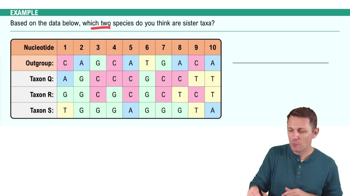
Building Phylogenetic Trees Example 2

Derived Characters

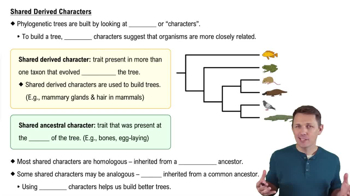
Derived characters are traits that appear in recent parts of a lineage but not in its older members. These traits are used to determine evolutionary relationships and are crucial for constructing phylogenetic trees. Derived characters help identify the point at which a particular trait evolved, marking a divergence in the evolutionary path.
Video consigliato:
Percorso guidato
05:42
Shared Derived Characters

Evolutionary Traits in Plants

In the context of plant evolution, traits such as flowers, embryos, seeds, and vascular tissue represent significant evolutionary advancements. Flowers are reproductive structures unique to angiosperms, seeds provide protection and nourishment to plant embryos, and vascular tissue allows for efficient transport of water and nutrients, supporting plant growth and diversification.
Video consigliato:
05:58
Vestigial Traits and Evolutionary Misconceptions