Ch. 36 - Resource Acquisition and Transport in Vascular Plants
Campbell - Campbell Biology 12th Edition
Urry12th EditionCampbell BiologyISBN: 9785794169850Non è quello che usi tu?Cambia libro di testo
Capitolo 36, Problema 4

Photosynthesis ceases when leaves wilt, mainly because
a. The chlorophyll in wilting leaves is degraded.
b. Accumulation of CO2 in the leaf inhibits enzymes.
c. Stomata close, preventing CO2 from entering the leaf.
d. Photolysis, the water-splitting step of photosynthesis, cannot occur when there is a water deficiency.

Guida verificata passo dopo passo
1
Understand the process of photosynthesis: Photosynthesis is the process by which green plants use sunlight to synthesize foods with the help of chlorophyll. It involves the intake of carbon dioxide (CO2) and water (H2O), and the release of oxygen (O2).
Recognize the role of stomata: Stomata are small openings on the surface of leaves that allow for gas exchange. They play a crucial role in photosynthesis by allowing CO2 to enter the leaf.
Consider the impact of wilting on stomata: When leaves wilt, it is often due to a lack of water. This causes the stomata to close to conserve water, which in turn prevents CO2 from entering the leaf.
Evaluate the options given: Analyze each option to determine which one directly relates to the closure of stomata and the prevention of CO2 entry. Option c states that stomata close, preventing CO2 from entering the leaf, which directly impacts photosynthesis.
Conclude the reasoning: Since CO2 is essential for photosynthesis, the closure of stomata due to wilting leads to a cessation of photosynthesis because the plant cannot take in the necessary CO2.

Risposta video verificata per un problema simile:

Questa soluzione video è stata consigliata dai nostri tutor come utile per risolvere questo problema.
Durata del video:
2m

Concetti chiave

Ecco i concetti essenziali che devi comprendere per rispondere correttamente alla domanda.

Photosynthesis

Photosynthesis is the process by which green plants, algae, and some bacteria convert light energy into chemical energy stored in glucose. It involves two main stages: the light-dependent reactions and the Calvin cycle. The process requires chlorophyll, water, and carbon dioxide, and produces oxygen as a byproduct.
Video consigliato:
05:58
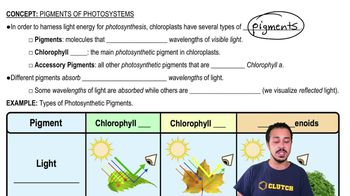
Pigments of Photosynthesis

Stomata Function

Stomata are small openings on the surface of leaves that regulate gas exchange. They allow CO2 to enter the leaf for photosynthesis and release oxygen as a byproduct. When leaves wilt, stomata close to conserve water, which prevents CO2 from entering, thus halting photosynthesis.
Video consigliato:
06:04
Functional Groups

Water's Role in Photosynthesis

Water is crucial for photosynthesis, particularly in the light-dependent reactions where it is split into oxygen, protons, and electrons during photolysis. A deficiency in water can impede this process, affecting the plant's ability to produce energy and leading to wilting and cessation of photosynthesis.
Video consigliato:
03:32
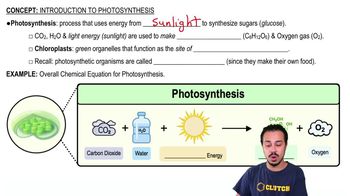
Introduction to Photosynthesis
Pratica correlata
Domanda del libro di testo

Compared with a cell with few aquaporin proteins in its membrane, a cell containing many aquaporin proteins will

a. Have a faster rate of osmosis

b. Have a lower water potential

c. Have a higher water potential

d. Accumulate water by active transport

1434
views
Domanda del libro di testo

What would enhance water uptake by a plant cell?

a. Decreasing the Ψ of the surrounding solution

b. Positive pressure on the surrounding solution

c. The loss of solutes from the cell

d. Increasing the Ψ of the cytoplasm

1268
views
Domanda del libro di testo

A plant cell with a ΨS of −0.65MPa maintains a constant volume when bathed in a solution that has a ΨS of −0.30MPa and is in an open container. The cell has a

a. ΨP of +0.65MPa

b. Ψ of −0.65MPa

c. ΨP of +0.35MPa

d. ΨP of 0 MPa

1083
views
Domanda del libro di testo

Which structure or compartment is part of the symplast?

a. The interior of a vessel element

b. The interior of a sieve tube

c. The cell wall of a mesophyll cell

d. An extracellular air space

1001
views
Domanda del libro di testo

Which of the following is an adaptation that enhances the uptake of water and minerals by roots?

a. Mycorrhizae

b. Pumping through plasmodesmata

c. Active uptake by vessel elements

d. Rhythmic contractions by cells in the root cortex

836
views
Domanda del libro di testo

Movement of phloem sap from a source to a sink

a. Occurs through the apoplast of sieve-tube elements

b. Depends ultimately on the activity of proton pumps

c. Depends on tension, or negative pressure potential

d. Results mainly from diffusion

1411
views