Ch. 39 - Plant Responses to Internal and External Signals
Campbell - Campbell Biology 12th Edition
Urry12th EditionCampbell BiologyISBN: 9785794169850Non è quello che usi tu?Cambia libro di testo
Capitolo 39, Problema 5

The signaling molecule for flowering might be released earlier than usual in a long-day plant exposed to flashes of:
a. Far-red light during the night
b. Red light during the night
c. Red light followed by far-red light during the night.
d. Far-red light during the day

Guida verificata passo dopo passo
1
Understand the concept of photoperiodism, which is the physiological reaction of organisms to the length of day or night. In plants, this often affects flowering.
Recognize that long-day plants require a longer duration of daylight to initiate flowering. They typically flower when the night is shorter than a critical length.
Identify the role of phytochromes, which are light receptors in plants that detect red and far-red light. Phytochromes exist in two forms: Pr (absorbs red light) and Pfr (absorbs far-red light).
Know that exposure to red light converts Pr to Pfr, which is the active form that promotes flowering in long-day plants. Conversely, far-red light converts Pfr back to Pr, inhibiting flowering.
Analyze the options: a flash of red light during the night would convert Pr to Pfr, potentially triggering flowering in long-day plants by simulating a shorter night. Therefore, consider how each option affects the Pr/Pfr balance and the plant's perception of night length.

Risposta video verificata per un problema simile:

Questa soluzione video è stata consigliata dai nostri tutor come utile per risolvere questo problema.
Durata del video:
5m

Concetti chiave

Ecco i concetti essenziali che devi comprendere per rispondere correttamente alla domanda.

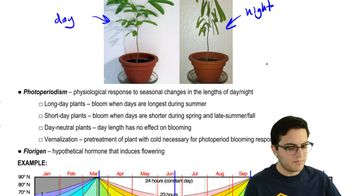
Photoperiodism

Photoperiodism is the physiological reaction of organisms to the length of day or night. In plants, it influences flowering and other developmental processes. Long-day plants require longer daylight periods to initiate flowering, and manipulating light exposure can alter their flowering time.
Video consigliato:
04:34
Photoderiodism

Phytochrome System

The phytochrome system is a light-sensitive mechanism in plants that detects red and far-red light. Phytochromes exist in two forms: Pr (red light-absorbing) and Pfr (far-red light-absorbing). The conversion between these forms regulates plant responses to light, including flowering, by affecting gene expression.
Video consigliato:
09:19
Immune System

Red and Far-Red Light Effects

Red and far-red light have distinct effects on plant physiology due to their interaction with phytochromes. Red light converts Pr to Pfr, promoting processes like flowering in long-day plants, while far-red light reverses this conversion. Alternating exposure to these lights can manipulate flowering signals, impacting the timing of flowering.
Video consigliato:
15:15
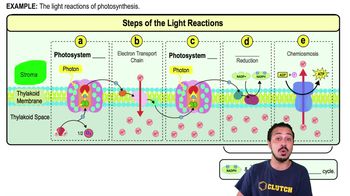
Steps of the Light Reactions
Pratica correlata
Domanda del libro di testo

A plant mutant that shows normal gravitropic bending but does not store starch in its plastids would require a reevaluation of the role of

a. Statoliths

b. Auxin

c. Calcium

d. Differential growth

1091
views
Domanda del libro di testo

A barley mutant lacking a gibberellic acid receptor would

a. Fail to make GA.

b. Catalyze starch more quickly.

c. Fail to make α-amylase.

d. Fail to take up water.

1243
views
Domanda del libro di testo

Indicate the response to each condition by drawing a straight seedling or one with the triple response.

846
views
Domanda del libro di testo

If a long-day plant has a critical night length of 9 hours, which 24-hour cycle would prevent flowering?

a. 16 hours light/8 hours dark

b. 14 hours light/10 hours dark

c. 4 hours light/8 hours dark/4 hours light/8 hours dark

d. 8 hours light/8 hours dark/light flash/8 hours dark

1079
views
Domanda del libro di testo

Charles and Francis Darwin discovered that

a. Auxin is responsible for phototropic curvature

b. Red light is most effective in shoot phototropism

c. Light destroys auxin

d. Light is perceived by the tips of coleoptiles

1763
views
1
rank
Domanda del libro di testo

How may a plant respond to severe heat stress?

a. By reorienting leaves to increase evaporative cooling

b. By creating air tubes for ventilation

c. By producing heat-shock proteins, which may protect the plant's proteins from denaturing

d. By increasing the proportion of unsaturated fatty acids in cell membranes, reducing their fluidity

1151
views