Ch. 4 - Carbon and the Molecular Diversity of Life
Campbell - Campbell Biology 12th Edition
Urry12th EditionCampbell BiologyISBN: 9785794169850Non è quello che usi tu?Cambia libro di testo
Capitolo 4, Problema 1

Organic chemistry is currently defined as
a. The study of compounds made only by living cells.
b. The study of carbon compounds.
c. The study of natural (as opposed to synthetic) compounds.
d. The study of hydrocarbons.

Guida verificata passo dopo passo
1
Understand the definition of organic chemistry: Organic chemistry is a branch of chemistry that focuses on the study of carbon-containing compounds.
Recognize that carbon compounds are central to organic chemistry: Carbon's ability to form stable bonds with many elements, including itself, makes it unique and central to organic chemistry.
Differentiate between natural and synthetic compounds: Organic chemistry includes both naturally occurring compounds and those synthesized in laboratories.
Identify hydrocarbons as a subset of organic compounds: Hydrocarbons, which consist solely of carbon and hydrogen, are a fundamental category within organic chemistry.
Consider the historical context: Historically, organic chemistry was thought to involve compounds produced by living organisms, but this definition has evolved to encompass all carbon-based compounds.

Risposta video verificata per un problema simile:

Questa soluzione video è stata consigliata dai nostri tutor come utile per risolvere questo problema.
Durata del video:
2m

Concetti chiave

Ecco i concetti essenziali che devi comprendere per rispondere correttamente alla domanda.

Carbon Compounds

Organic chemistry primarily focuses on carbon compounds, which are molecules containing carbon atoms bonded to other elements like hydrogen, oxygen, and nitrogen. Carbon's ability to form stable covalent bonds with various elements makes it central to organic chemistry, allowing for a vast diversity of structures and functions in organic molecules.
Video consigliato:
04:19
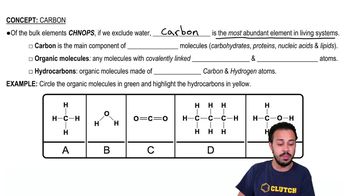
Carbon

Hydrocarbons

Hydrocarbons are organic compounds consisting entirely of hydrogen and carbon. They form the simplest class of organic molecules and serve as the foundation for more complex structures. Understanding hydrocarbons is essential in organic chemistry as they are involved in energy production and serve as precursors for various chemical reactions.
Video consigliato:
04:19
Carbon

Natural vs. Synthetic Compounds

Organic chemistry encompasses both natural and synthetic compounds. Natural compounds are those found in nature, produced by living organisms, while synthetic compounds are artificially created in laboratories. The study of both types is crucial for applications ranging from pharmaceuticals to materials science, highlighting the versatility and importance of organic chemistry.
Video consigliato:
Percorso guidato
04:43
Natural Selection