
Ch. 43 - The Immune System
Campbell - Campbell Biology 12th Edition
Urry12th EditionCampbell BiologyISBN: 9785794169850Non è quello che usi tu?Cambia libro di testo
Capitolo 43, Problema 5

Which of the following should be the same in identical twins?
a. The set of antibodies produced
b. The set of MHC molecules produced
c. The set of T cell antigen receptors produced
d. The set of immune cells eliminated as self-reactive

Guida verificata passo dopo passo
1
Understand that identical twins originate from the same fertilized egg, meaning they have the same genetic material.
Recall that the Major Histocompatibility Complex (MHC) molecules are encoded by genes that are highly polymorphic, but identical twins have the same alleles for these genes.
Consider that the set of antibodies produced can vary due to environmental factors and exposure to different pathogens, even in identical twins.
Recognize that T cell antigen receptors are generated through a random recombination process, which can lead to differences even in genetically identical individuals.
Identify that the set of immune cells eliminated as self-reactive is influenced by the genetic makeup, which is identical in twins, leading to the same set of self-reactive cells being eliminated.

Risposta video verificata per un problema simile:

Questa soluzione video è stata consigliata dai nostri tutor come utile per risolvere questo problema.
Durata del video:
3m

Concetti chiave

Ecco i concetti essenziali che devi comprendere per rispondere correttamente alla domanda.

Identical Twins

Identical twins, also known as monozygotic twins, originate from a single fertilized egg that splits into two embryos. This results in twins with identical genetic material, meaning they share the same DNA. This genetic similarity is crucial for understanding why certain biological characteristics, such as genetic markers, are the same in identical twins.
Video consigliato:
08:09
Homologous Chromosomes

Major Histocompatibility Complex (MHC)

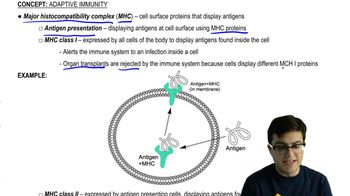
The Major Histocompatibility Complex (MHC) is a set of cell surface proteins essential for the acquired immune system to recognize foreign molecules. MHC molecules are encoded by a highly polymorphic set of genes, meaning they vary greatly between individuals. However, identical twins have the same set of MHC molecules due to their identical genetic makeup, which is critical for tissue compatibility and immune response.
Video consigliato:
04:04
Major Histocompatibility Complex

T Cell Antigen Receptors

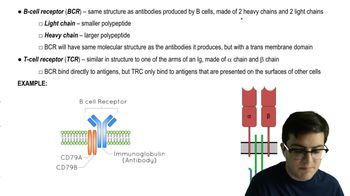
T cell antigen receptors are molecules found on the surface of T cells that allow them to recognize and bind to specific antigens. These receptors are generated through a process of genetic recombination, leading to a diverse repertoire in each individual. In identical twins, the genetic potential for producing T cell receptors is the same, but the actual set of receptors can differ due to random recombination events during immune cell development.
Video consigliato:
03:50
Antigen Receptors