Ch. 46 - Animal Reproduction
Campbell - Campbell Biology 12th Edition
Urry12th EditionCampbell BiologyISBN: 9785794169850Non è quello che usi tu?Cambia libro di testo
Capitolo 46, Problema 1

Which of the following characterizes parthenogenesis?
a. An individual may change its sex during its lifetime.
b. Specialized groups of cells grow into new individuals.
c. An organism is first a male and then a female.
d. An egg develops without being fertilized.

Guida verificata passo dopo passo
1
Understand the concept of parthenogenesis: It is a form of asexual reproduction where an egg develops into an individual without fertilization.
Analyze option a: Changing sex during a lifetime is known as sequential hermaphroditism, not parthenogenesis.
Analyze option b: Specialized groups of cells growing into new individuals is a form of asexual reproduction called budding, not parthenogenesis.
Analyze option c: Being first male and then female is another form of sequential hermaphroditism, not parthenogenesis.
Analyze option d: This describes parthenogenesis accurately, as it involves an egg developing without fertilization.

Risposta video verificata per un problema simile:

Questa soluzione video è stata consigliata dai nostri tutor come utile per risolvere questo problema.
Durata del video:
2m

Concetti chiave

Ecco i concetti essenziali che devi comprendere per rispondere correttamente alla domanda.

Parthenogenesis

Parthenogenesis is a form of asexual reproduction where an egg develops into a new individual without fertilization. This process occurs naturally in some plants, invertebrates, and vertebrates, allowing for reproduction without the genetic contribution of a male. It is distinct from sexual reproduction, as it involves only one parent.
Video consigliato:
06:30
Mollusks

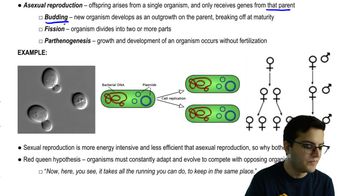
Asexual Reproduction

Asexual reproduction is a mode of reproduction that does not involve the fusion of gametes or change in the number of chromosomes. It results in offspring that are genetically identical to the parent organism. This type of reproduction is common in single-celled organisms and some multicellular organisms, providing a rapid means of population increase.
Video consigliato:
05:44
Sexual and Asexual Reproduction

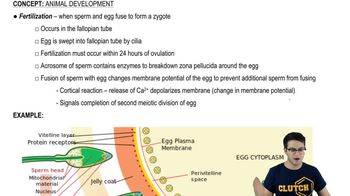
Fertilization

Fertilization is the process by which male and female gametes (sperm and egg) fuse to form a zygote, initiating the development of a new organism. It is a key component of sexual reproduction, ensuring genetic diversity through the combination of genetic material from two parents. In contrast, parthenogenesis bypasses this process, leading to offspring from a single parent.
Video consigliato:
01:59
Fertilization