
Ch. 48 - Neurons, Synapses, and Signaling
Campbell - Campbell Biology 12th Edition
Urry12th EditionCampbell BiologyISBN: 9785794169850Non è quello che usi tu?Cambia libro di testo
Capitolo 48, Problema 3

Where are neurotransmitter receptors located?
a. The nuclear membrane
b. The nodes of Ranvier
c. The postsynaptic membrane
d. Synaptic vesicle membranes

Guida verificata passo dopo passo
1
Identify the location where neurotransmitter receptors are typically found. Neurotransmitter receptors are proteins that respond to chemical signals transmitted across a synapse from one neuron to another.
Understand the role of the postsynaptic membrane. It is the part of the neuron that receives signals (neurotransmitters) from the presynaptic neuron and contains receptors that neurotransmitters bind to.
Eliminate other options: The nuclear membrane is involved in protecting the nucleus and does not play a direct role in neurotransmission. The nodes of Ranvier are gaps in the myelin sheath of axons, which facilitate rapid signal transmission but do not contain neurotransmitter receptors. Synaptic vesicle membranes are found in the presynaptic neuron and contain neurotransmitters, not the receptors.

Risposta video verificata per un problema simile:

Questa soluzione video è stata consigliata dai nostri tutor come utile per risolvere questo problema.
Durata del video:
47s

Concetti chiave

Ecco i concetti essenziali che devi comprendere per rispondere correttamente alla domanda.

Neurotransmitter Receptors

Neurotransmitter receptors are specialized protein molecules located on the surface of neurons. They bind to neurotransmitters released from the presynaptic neuron, facilitating the transmission of signals across synapses. These receptors are crucial for the communication between neurons and play a key role in the nervous system's function.
Video consigliato:
02:28
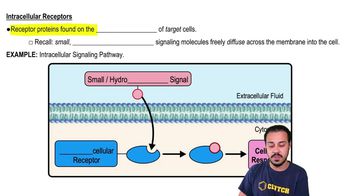
Intracellular Receptors

Postsynaptic Membrane

The postsynaptic membrane is the part of the neuron that receives signals from the presynaptic neuron. It is located on the dendrites or cell body of the neuron and contains neurotransmitter receptors. When neurotransmitters bind to these receptors, they trigger a response in the postsynaptic neuron, continuing the transmission of the neural signal.
Video consigliato:
05:33
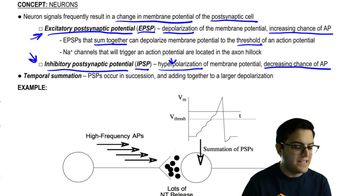
Postsynaptic Potentials and Summation

Synaptic Transmission

Synaptic transmission is the process by which neurons communicate with each other. It involves the release of neurotransmitters from the presynaptic neuron into the synaptic cleft, where they bind to receptors on the postsynaptic membrane. This binding initiates a response in the postsynaptic neuron, allowing the signal to be propagated through the nervous system.
Video consigliato:
02:50
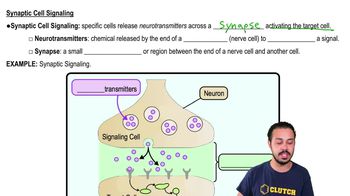
Synaptic Cell Signaling
Pratica correlata
Domanda del libro di testo

Suppose a particular neurotransmitter causes an IPSP in postsynaptic cell X and an EPSP in postsynaptic cell Y. A likely explanation is that

a. The threshold value in the postsynaptic membrane is different for cell X and cell Y

b. The axon of cell X is myelinated, but that of cell Y is not

c. Only cell Y produces an enzyme that terminates the activity of the neurotransmitter

d. Cells X and Y express different receptor molecules for this particular neurotransmitter

1265
views
Domanda del libro di testo

Which of the following is the most direct result of depolarizing the presynaptic membrane of an axon terminal?

a. Voltage-gated calcium channels in the membrane open

b. Synaptic vesicles fuse with the membrane

c. Ligand-gated channels open, allowing neurotransmitters to enter the synaptic cleft

d. An EPSP or IPSP is generated in the postsynaptic cell

1519
views
Domanda del libro di testo

A common feature of action potentials is that they

a. Cause the membrane to hyperpolarize and then depolarize

b. Can undergo temporal and spatial summation

c. Are triggered by a depolarization that reaches threshold

d. Move at the same speed along all axons

1513
views
Domanda del libro di testo

Why are action potentials usually conducted in one direction?

a. Ions can flow along the axon in only one direction

b. The brief refractory period prevents the reopening of voltage-gated Na⁺ channels

c. The axon hillock has a higher membrane potential than the terminals of the axon

d. Voltage-gated channels for both Na⁺ and K⁺ open in only one direction.

2992
views
Domanda del libro di testo

What happens when a resting neuron's membrane depolarizes?

a. There is a net diffusion of Na⁺ out of the cell

b. The equilibrium potential for K⁺ (Eₖ) becomes more positive

c. The neuron's membrane voltage becomes more positive

d. The cell's inside is more negative than the outside

2288
views