Ch. 53 - Population Ecology
Campbell - Campbell Biology 12th Edition
Urry12th EditionCampbell BiologyISBN: 9785794169850Non è quello che usi tu?Cambia libro di testo
Capitolo 53, Problema 2

A population's carrying capacity
a. May change as environmental conditions change
b. Can be accurately calculated using the logistic growth model
c. Increases as the per capita population growth rate decreases
d. Can never be exceeded

Guida verificata passo dopo passo
1
Understand the concept of carrying capacity: Carrying capacity is the maximum number of individuals in a population that the environment can sustain indefinitely without degrading the environment.
Consider how environmental conditions affect carrying capacity: Carrying capacity is not a fixed number and can change with variations in environmental conditions such as availability of resources, habitat space, and climate.
Examine the logistic growth model: The logistic growth model describes how a population grows more slowly as it approaches its carrying capacity. The model is represented by the equation: dN/dt=rN(1-N/K), where N is the population size, r is the intrinsic growth rate, and K is the carrying capacity.
Analyze the relationship between per capita growth rate and carrying capacity: The per capita growth rate typically decreases as the population approaches carrying capacity due to increased competition for limited resources.
Evaluate the possibility of exceeding carrying capacity: While populations can temporarily exceed carrying capacity, this often leads to resource depletion and a subsequent decrease in population size, bringing it back to or below the carrying capacity.

Risposta video verificata per un problema simile:

Questa soluzione video è stata consigliata dai nostri tutor come utile per risolvere questo problema.
Durata del video:
2m

Concetti chiave

Ecco i concetti essenziali che devi comprendere per rispondere correttamente alla domanda.

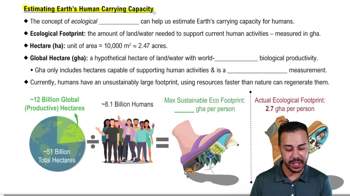
Carrying Capacity

Carrying capacity refers to the maximum number of individuals in a population that an environment can sustain indefinitely without degrading the environment. It is influenced by factors such as food availability, habitat space, and water supply, and can change with alterations in these environmental conditions.
Video consigliato:
06:24
Estimating Earth’s Human Carrying Capacity

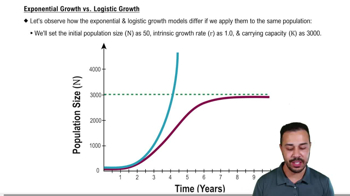
Logistic Growth Model

The logistic growth model describes how a population grows more slowly as it approaches its carrying capacity. It is represented by an S-shaped curve, where growth is rapid initially but slows as resources become limited, eventually stabilizing when the carrying capacity is reached. This model helps estimate population dynamics under resource constraints.
Video consigliato:
09:46
Exponential Growth vs. Logistic Growth

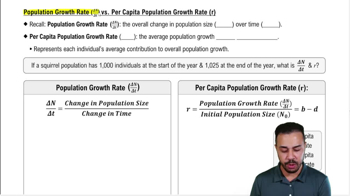
Per Capita Population Growth Rate

Per capita population growth rate is the average rate at which individual members of a population contribute to the overall growth of the population. It is calculated by considering births and deaths per individual. A decrease in this rate often indicates that the population is nearing its carrying capacity, as resources become scarce and competition increases.
Video consigliato:
03:26
Population Growth Rate vs. Per Capita Population Growth Rate