Ch. 55 - Ecosystems and Restoration Ecology
Campbell - Campbell Biology 12th Edition
Urry12th EditionCampbell BiologyISBN: 9785794169850Non è quello che usi tu?Cambia libro di testo
Capitolo 55, Problema 5

Which of the following has the greatest effect on the rate of chemical cycling in an ecosystem?
a. The rate of decomposition in the ecosystem
b. The production efficiency of the ecosystem's consumers
c. The trophic efficiency of the ecosystem
d. The location of the nutrient reservoirs in the ecosystem

Guida verificata passo dopo passo
1
Understand that chemical cycling in an ecosystem refers to the movement and exchange of organic and inorganic matter back into the production of living matter.
Recognize that decomposition is a critical process in chemical cycling, as it breaks down dead organic material, returning nutrients to the soil and making them available for producers.
Consider the role of decomposers, such as bacteria and fungi, which are responsible for breaking down complex organic materials into simpler substances.
Evaluate how the rate of decomposition directly affects the speed at which nutrients are recycled and made available to primary producers, thus influencing the overall rate of chemical cycling.
Conclude that among the given options, the rate of decomposition in the ecosystem (option a) has the greatest effect on the rate of chemical cycling, as it directly impacts the availability of nutrients for other organisms.

Risposta video verificata per un problema simile:

Questa soluzione video è stata consigliata dai nostri tutor come utile per risolvere questo problema.
Durata del video:
2m

Concetti chiave

Ecco i concetti essenziali che devi comprendere per rispondere correttamente alla domanda.

Rate of Decomposition

The rate of decomposition refers to how quickly organic matter is broken down into simpler substances by decomposers like bacteria and fungi. This process is crucial for recycling nutrients back into the ecosystem, influencing the availability of essential elements for plant growth and overall ecosystem productivity.
Video consigliato:
07:08
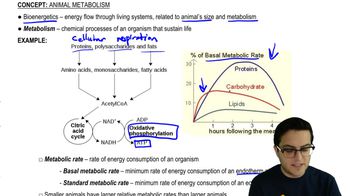
Metabolic Rate

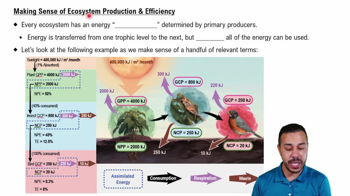
Production Efficiency

Production efficiency is the measure of how effectively consumers in an ecosystem convert the energy they ingest into biomass. It affects the energy flow and nutrient cycling within the ecosystem, as higher efficiency means more energy is retained within the consumer level, potentially impacting the rate of chemical cycling.
Video consigliato:
07:47
Making Sense of Ecosystem Production & Efficiency

Trophic Efficiency

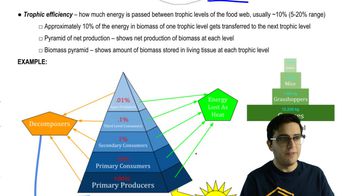
Trophic efficiency describes the percentage of energy transferred from one trophic level to the next in an ecosystem. It is a key factor in determining the energy flow and nutrient cycling, as lower efficiency results in less energy being passed up the food chain, affecting the overall dynamics and chemical cycling rates.
Video consigliato:
03:30
Secondary Production and Trophic Efficiency
Pratica correlata
Domanda del libro di testo

The discipline that applies ecological principles to returning degraded ecosystems to a more natural state is known as

a. Restoration ecology

b. Thermodynamics

c. Eutrophication

d. Biogeochemistry

1179
views

Domanda del libro di testo

Which of the following would be considered an example of bioremediation?

a. Adding nitrogen-fixing microorganisms to a degraded ecosystem to increase nitrogen availability

b. Using a bulldozer to regrade a strip mine

c. Reconfiguring the channel of a river

d. Adding seeds of a chromium-accumulating plant to soil contaminated by chromium

1450
views
Domanda del libro di testo

Which of these ecosystems has the lowest net primary production per square meter?

a. A salt marsh

b. An open ocean

c. A coral reef

d. A tropical rain forest

1155
views
Domanda del libro di testo

Nitrifying bacteria participate in the nitrogen cycle mainly by

a. Converting nitrogen gas to ammonia

b. Releasing ammonium from organic compounds, thus returning it to the soil

c. Converting ammonium to nitrate, which plants absorb

d. Incorporating nitrogen into amino acids and organic compounds

1867
views
Domanda del libro di testo

If you applied a fungicide to a cornfield, what would you expect to happen to the rate of decomposition and net ecosystem production (NEP)?

a. Both decomposition rate and NEP would decrease.

b. Neither would change.

c. Decomposition rate would increase and NEP would decrease.

d. Decomposition rate would decrease and NEP would increase.

1635
views
1
rank
Domanda del libro di testo

Which of the following was a result of the Hubbard Brook watershed deforestation experiment?

a. Most minerals were not recycled within the intact forest ecosystem

b. Calcium levels remained high in the soil of deforested areas

c. Deforestation decreased water runoff

d. The nitrate concentration in waters draining the deforested area became dangerously high

1387
views