

Ch. 56 - Conservation Biology and Global Change
Campbell - Campbell Biology 12th Edition
Urry12th EditionCampbell BiologyISBN: 9785794169850Non è quello che usi tu?Cambia libro di testo
Capitolo 56, Problema 2

The main cause of the increase in the amount of CO₂ in Earth’s atmosphere over the past 170 years is
a. Increased worldwide primary production
b. Increased worldwide fertilizer production
c. Increased infrared radiation absorption by the atmosphere
d. The burning of fossil fuels and deforestation

Guida verificata passo dopo passo
1
Understand the context of the problem: The question is asking about the primary cause of the increase in CO2 levels in Earth's atmosphere over the past 170 years. This requires knowledge of human activities and their impact on the carbon cycle.
Review the options provided: Analyze each choice to determine its relevance to the increase in CO2 levels. For example, primary production refers to photosynthesis, which typically reduces CO2, not increases it.
Consider historical events: Over the past 170 years, industrialization has significantly increased, leading to activities such as burning fossil fuels (coal, oil, natural gas) and deforestation, both of which release large amounts of CO2 into the atmosphere.
Eliminate incorrect options: Increased fertilizer production (Option B) contributes to nitrogen cycle changes, not directly to CO2 levels. Increased infrared radiation absorption (Option C) is a consequence of higher CO2 levels, not the cause.
Identify the correct answer: The burning of fossil fuels and deforestation (Option D) are well-documented as the primary drivers of increased CO2 levels due to human activities, making this the most accurate choice.

Risposta video verificata per un problema simile:

Questa soluzione video è stata consigliata dai nostri tutor come utile per risolvere questo problema.
Durata del video:
1m

Concetti chiave

Ecco i concetti essenziali che devi comprendere per rispondere correttamente alla domanda.

Carbon Dioxide Emissions

Carbon dioxide (CO2) is a greenhouse gas that traps heat in the atmosphere. Its levels have significantly increased due to human activities, particularly the burning of fossil fuels like coal, oil, and natural gas, which release CO2 as a byproduct. Understanding the sources of CO2 emissions is crucial for addressing climate change and its impacts.
Video consigliato:
04:19
Carbon

Deforestation

Deforestation refers to the large-scale removal of trees from forested areas, which reduces the number of trees available to absorb CO2 from the atmosphere. This process not only contributes to increased CO2 levels but also disrupts ecosystems and biodiversity. The loss of forests exacerbates climate change by diminishing a natural carbon sink.
Video consigliato:
03:23
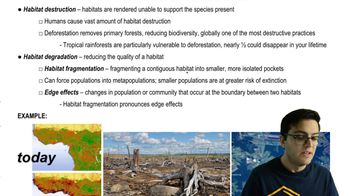
Habitat Destruction and Degradation

Greenhouse Effect

The greenhouse effect is a natural process where certain gases in the Earth's atmosphere trap heat, keeping the planet warm enough to support life. However, human activities, particularly the burning of fossil fuels and deforestation, have intensified this effect by increasing the concentration of greenhouse gases like CO2, leading to global warming and climate change.
Video consigliato:
04:52
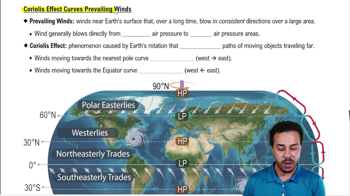
Coriolis Effect Curves Prevailing Winds
Pratica correlata
Domanda del libro di testo

Which of these is a consequence of biological magnification?

a. Toxic chemicals in the environment pose greater risk to top-level predators than to primary consumers.

b. Populations of top-level predators are generally smaller than populations of primary consumers.

c. The biomass of producers in an ecosystem is generally higher than the biomass of primary consumers.

d. Only a small portion of the energy captured by producers is transferred to consumers.

853
views
Domanda del libro di testo

Which of the following strategies would most rapidly increase the genetic diversity of a population in an extinction vortex?

a. Establish a reserve that protects the population's habitat

b. Introduce new individuals transported from other populations of the same species

c. Sterilize the least fit individuals in the population

d. Control populations of the endangered population's predators and competitors

1236
views
Domanda del libro di testo

What is the single greatest threat to biodiversity?

a. Overharvesting of commercially important species

b. Habitat alteration, fragmentation, and destruction

c. Introduced species that compete with native species

d. Novel pathogens

1253
views
Domanda del libro di testo

One characteristic that distinguishes a population in an extinction vortex from most other populations is that

a. It is a rare, top-level predator

b. Its effective population size is lower than its total population size

c. Its genetic diversity is very low

d. It is not well adapted to edge conditions

917
views
1
comments