

Ch. 7 - Membrane Structure and Function
Campbell - Campbell Biology 12th Edition
Urry12th EditionCampbell BiologyISBN: 9785794169850Non è quello che usi tu?Cambia libro di testo
Capitolo 7, Problema 1

In what way do the membranes of a eukaryotic cell vary?
a. Phospholipids are found only in certain membranes.
b. Certain proteins are unique to each membrane.
c. Only certain membranes of the cell are selectively permeable.
d. Only certain membranes are constructed from amphipathic molecules.

Guida verificata passo dopo passo
1
Understand that eukaryotic cells have various types of membranes, each with specific functions and compositions.
Recognize that phospholipids are a fundamental component of all eukaryotic cell membranes, not just certain ones, making option a incorrect.
Identify that proteins embedded in membranes can vary significantly between different types of membranes, as they are tailored to the specific functions of each membrane, supporting option b.
Recall that all eukaryotic cell membranes exhibit selective permeability, allowing certain substances to pass while blocking others, which makes option c incorrect.
Note that amphipathic molecules, such as phospholipids, are a common structural feature of all cell membranes, not just certain ones, making option d incorrect.

Risposta video verificata per un problema simile:

Questa soluzione video è stata consigliata dai nostri tutor come utile per risolvere questo problema.
Durata del video:
41s

Concetti chiave

Ecco i concetti essenziali che devi comprendere per rispondere correttamente alla domanda.

Membrane Composition

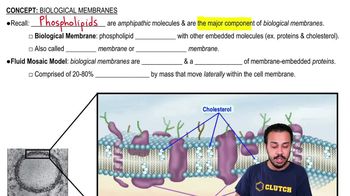
Eukaryotic cell membranes are primarily composed of a phospholipid bilayer, which provides structural integrity and fluidity. Phospholipids are amphipathic molecules, meaning they have both hydrophilic and hydrophobic parts, allowing them to form bilayers. While phospholipids are common to all membranes, the specific types and ratios can vary, influencing membrane properties.
Video consigliato:
06:04
Biological Membranes

Membrane Proteins

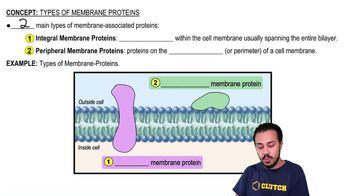
Membrane proteins are crucial for various functions, including transport, signaling, and structural support. Each membrane within a eukaryotic cell can have a unique set of proteins tailored to its specific function. For example, the mitochondrial membrane has proteins involved in energy production, while the plasma membrane contains receptors for cell communication.
Video consigliato:
02:35
Types of Membrane Proteins

Selective Permeability

Selective permeability refers to a membrane's ability to regulate the passage of substances. This property is essential for maintaining homeostasis within the cell. While all eukaryotic membranes exhibit selective permeability to some degree, the extent and specificity can vary depending on the membrane's role, such as the nuclear envelope selectively allowing RNA and proteins to pass.
Video consigliato:
Percorso guidato
04:43
Natural Selection